The Explainer
What do most people miss when they underwrite a small multifamily?
Fernando, founder of Senjo · 7 min read
TL;DR
A listing pro forma describes the seller's ownership of the building, not yours. Six lines get missed most: vacancy, reassessed property taxes, management, capex reserves, repairs, and insurance. On one illustrative 4 unit, correcting those six took net operating income from 62,800 dollars to 43,100, and an advertised 10 percent cap was really a 6.9. The deal still produced positive cash flow. It failed anyway, because DSCR came in at 1.15 against a 1.25 lender floor. The fix was not to walk. It was a number, 584,000 dollars instead of 625,000.
What does a listing pro forma actually show you?
It shows you the seller's ownership of the building, not yours. Every number on it can be true and still be useless to you. The taxes were assessed years ago, on a value nobody has revisited since. The insurance is a legacy policy written for a legacy owner. There is no management line, because the seller runs it himself on Saturdays. There are no reserves, because the seller stopped funding them a decade ago and the roof has held.
The broker is not lying. He is quoting an operating history. The mistake is reading a history as a forecast. And a 10 percent cap that is still sitting on the market is a question, not a gift. When the advertised return looks too good for the asking price, the expenses are usually where the answer is hiding.
What are the six lines most first-timers miss?
Six of them: vacancy, property taxes after reassessment, management, capex reserves, repairs, and insurance. Five are missing because the seller's situation made them invisible. One is missing because it has not happened yet.
Vacancy and credit loss. The listing shows twelve months of full collection. Nobody collects twelve months of full rent forever. Price 5 percent and move on.
Property taxes after reassessment. This is the one that has not happened yet, and it is the one that hurts. In most jurisdictions the assessed value resets when the building sells, and it resets to roughly what you paid. The seller's tax bill is real. It is also not your tax bill. Rules vary by state and county, so confirm yours.
Management. Price it at 8 percent of collected rent whether you hire it out or not. If you self-manage, you did not save the fee. You bought a job. Price the line first, then decide whether you want the work.
Capex reserves. The roof, the boiler, and the parking lot do not show up in an operating statement, because they do not happen every year. They happen. Fund 5 percent of gross rent as a floor.
Repairs and maintenance. Budget around 1,200 dollars per unit per year on an older building. Sellers routinely show half that, because they did the work themselves and never priced their time.
Insurance. The seller's policy does not transfer to you at the seller's rate. Get a real quote before you reach the closing table.

What do those six lines do to a real deal?
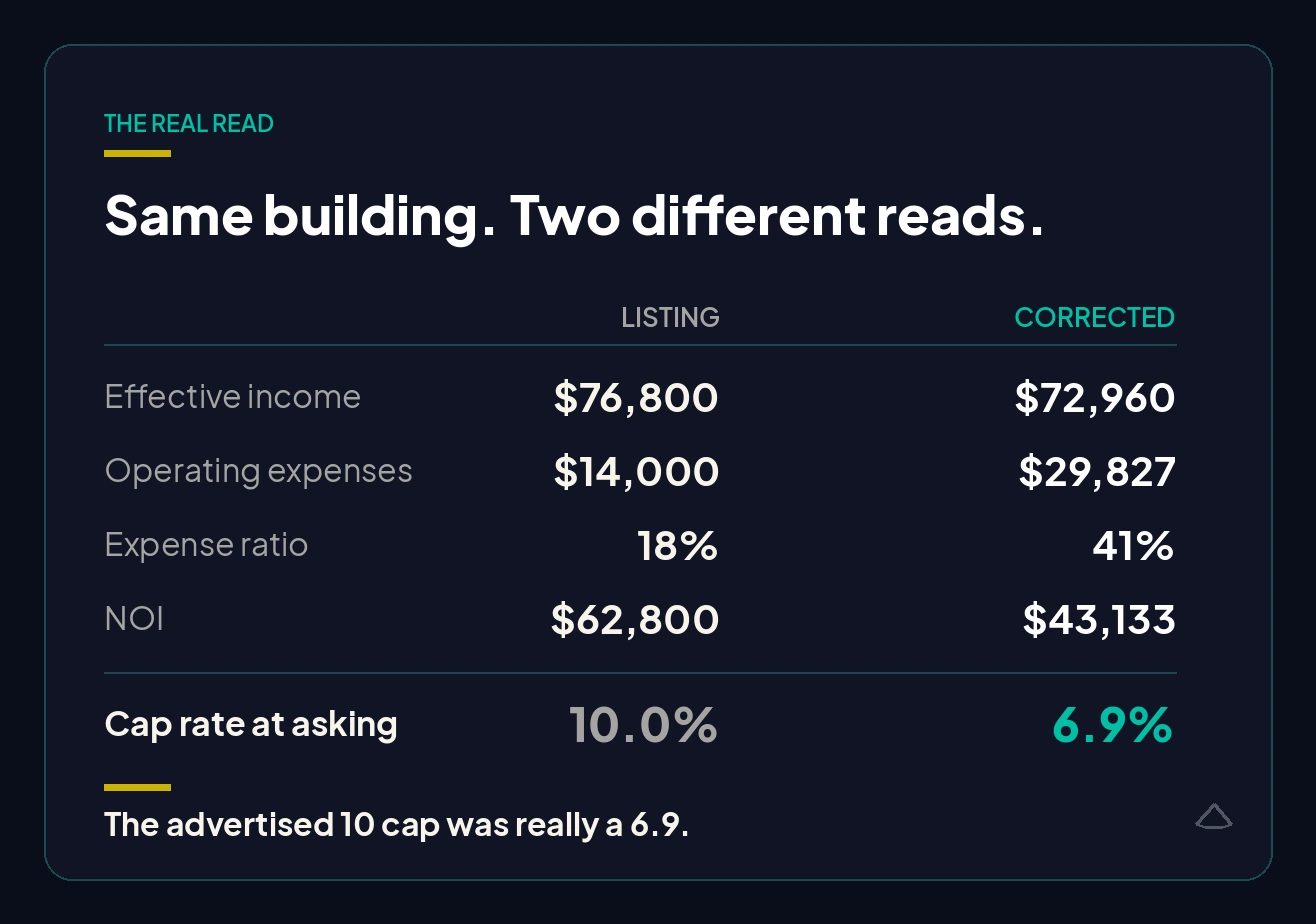
They cut net operating income by 31 percent, and they take an advertised 10 percent cap down to a real cap rate of 6.9. Start with an illustrative 4 unit listed at 625,000 dollars. Four units at 1,600 dollars a month is 76,800 dollars of gross scheduled rent. On the listing, expenses total 14,000 dollars, an 18 percent expense ratio, which leaves 62,800 dollars of net operating income and that advertised 10 percent cap. An 18 percent expense ratio on a 1970s fourplex is not an achievement. It is a tell.
Now correct it. Price a 5 percent vacancy, and effective income falls to 72,960 dollars. Reassess the taxes to the purchase price, and the tax line climbs from 4,800 dollars to 8,750. Reprice the insurance at transfer, from 3,000 dollars to 4,200. Put repairs at 1,200 dollars a unit, so 4,800. Add the management line the seller left at zero, 8 percent of collected rent, 5,837 dollars. Fund reserves at 5 percent of gross rent, 3,840 dollars. Corrected expenses come to 29,827 dollars, a 41 percent expense ratio, and net operating income of 43,133. The real cap rate at asking is 6.9 percent, not 10.
The worked example below shows where the 19,667 dollar cut landed, line by line. Notice which line is the biggest. It is not the tax reassessment, the one everybody warns you about. It is management, the line that was set to zero because the seller works for free.
Why did a deal that still cash flowed fail anyway?
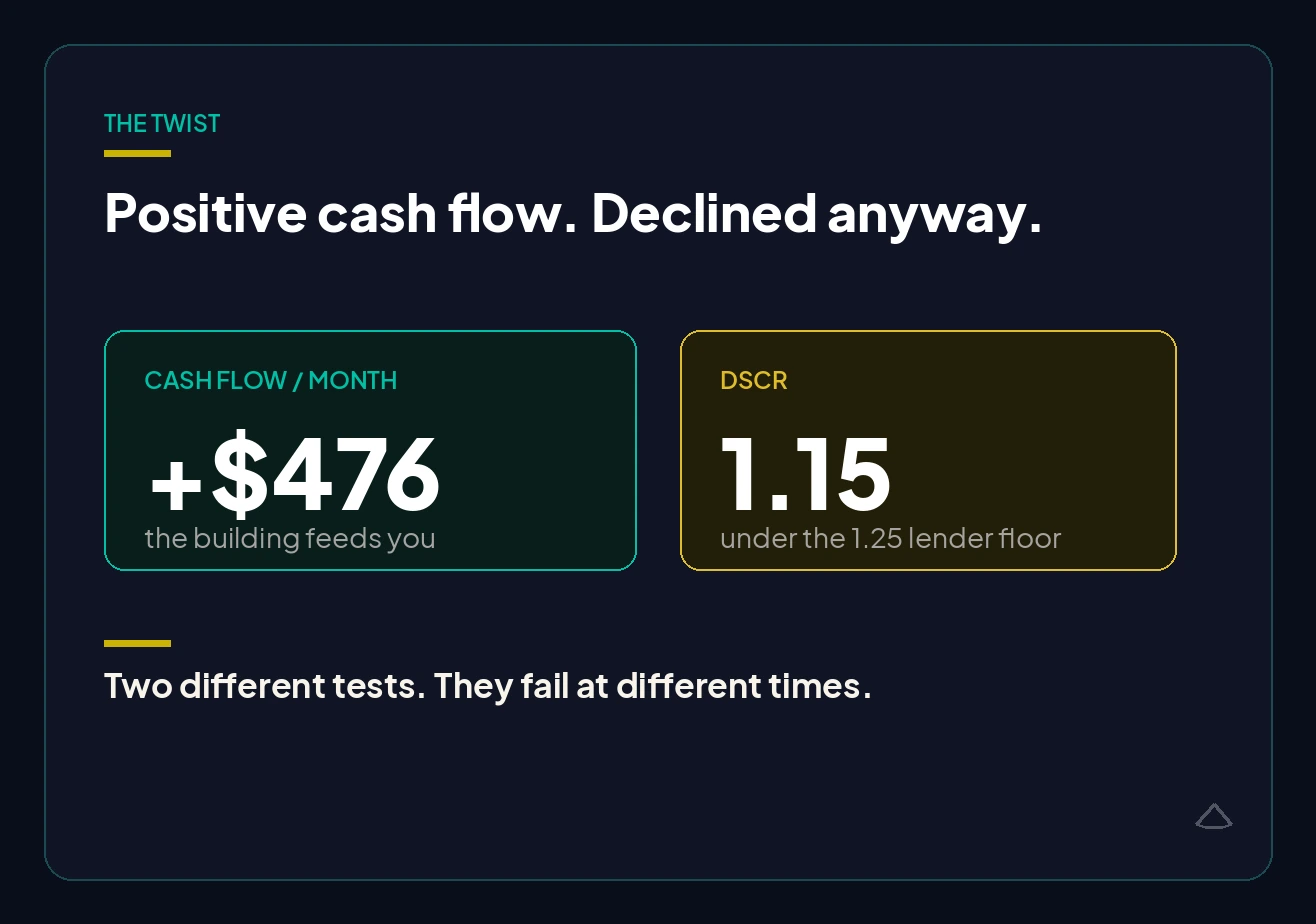
Because cash flow is not the number the lender is looking at. DSCR is. At the asking price this deal cleared 476 dollars a month and still would not finance. Run the debt. A 75 percent loan on 625,000 dollars is 468,750. At 7 percent on a 30 year amortization, that is 37,423 dollars a year in debt service. Against corrected net operating income of 43,133 dollars, that leaves 5,710 dollars a year, or 476 a month. Positive. And a DSCR of 1.15, against a lender floor that is typically 1.25.
This is the part that catches people. You check cash flow, you see a positive number, you feel good, and you take the deal to a lender who declines it. The deal did not die on the thing you were watching. It died on the thing you were not. Cash flow tells you whether the building feeds you. DSCR tells you whether the bank believes it. They are different questions, and they fail at different times.
What do you do with the corrected number?
You do not walk. You reprice. On this deal the number that works is 584,000 dollars. Solve backward from the lender's floor rather than forward from the seller's hope. To hit a 1.25 DSCR at 7 percent with 75 percent leverage, the price has to come down to about 584,000. That is 7 percent under asking, roughly 41,000. Not a fantasy discount. A negotiation.
Net operating income even rises slightly at the lower price, to 43,707 dollars, because you are reassessed on what you pay. A lower price is a permanently lower tax bill, every year you own it. The DSCR clears at 1.25, the cap rate reads 7.5 percent, and monthly cash flow moves to 728 dollars.
So the read gives you three moves, in order.
Reprice. Offer 584,000 dollars and show your work. A seller who has watched a 10 percent cap sit on the market has already met the market. Your corrected pro forma is the reason the last three buyers walked.
Restructure. If the seller will not move on price, move the terms. A seller carry at a lower rate, or a longer amortization, changes the debt service and can rescue the DSCR without the seller taking a haircut on the headline number.
Walk. If neither moves, you now have a reason, not a feeling. It is the same read that turned a real 6 unit into a walk, when no financing path cleared the ask.
One honest caveat
The corrected read above is still optimistic. At a 41 percent operating expense ratio, this deal is running under the old 50 percent rule of thumb, which says operating expenses on a small multifamily tend to land near half of gross rent. Half of 76,800 dollars is 38,400. The corrected read came in at 29,827.
That does not mean the corrected read is wrong. It means it is the floor, not the ceiling. A real deal deserves real quotes on taxes, insurance, and management before you sign anything. The point of the exercise is not to land on a perfect number. It is to stop underwriting somebody else's building.
Worked example, illustrative
| Management priced at zero | - $5,837 |
| Property tax reassessment | - $3,950 |
| Vacancy never priced | - $3,840 |
| Capex reserves priced at zero | - $3,840 |
| Insurance understated | - $1,200 |
| Repairs understated | - $1,000 |
| Total cut to NOI | - $19,667 |
Illustrative 4 unit listed at 625,000 dollars. Correcting the six missed lines took net operating income from 62,800 dollars to 43,133, a 31 percent cut, and the advertised 10 percent cap to a real 6.9. Debt assumptions: 75 percent LTV, 7.0 percent, 30 year amortization. Run your own quotes on taxes, insurance, and management before you trust any of it.
Frequently asked
What expense ratio should I use for a small multifamily?
Start at 40 to 50 percent of gross rent, then replace the estimate with real numbers as you get them. If a listing shows an expense ratio under about 30 percent, treat it as a flag rather than a feature. It usually means the seller self-manages, self-repairs, or funds no reserves.
Do property taxes really go up when I buy?
In most jurisdictions, yes. The assessed value resets on sale to roughly the price paid, so the seller's tax line understates yours by whatever the building has appreciated since it was last assessed. The rules vary by state and county, and a few places cap the increase. Confirm with the county assessor before you underwrite the deal.
Should I include a management fee if I plan to self-manage?
Yes. Price it at 8 percent of collected rent, then decide. Self-managing does not eliminate the cost. It converts it into your time. If the deal only works because you are willing to work for free, you have not found a good deal. You have found a job with a mortgage attached.
What DSCR do lenders require on a small multifamily?
A 1.25 floor is typical, though it moves with the lender, the loan product, and the borrower. The number that matters is that DSCR and cash flow are different tests. A deal can show positive cash flow and still be declined for a DSCR under the floor.
Is a high advertised cap rate a good sign?
Not on its own. An advertised cap rate is built on the seller's expenses, so an unusually high one often means the expenses are unusually incomplete. When a high cap rate sits on the market for a while, the expenses are the first place to look.
Senjo is an AI sensei for solo multifamily investors. Fernando, its founder, owns two single family rentals and is working toward his first small multifamily deal, building the tool he needed when he got stuck between the two.