The Explainer
Why is your insurance quote higher than the number on the listing?
Fernando, founder of Senjo · 7 min read
TL;DR
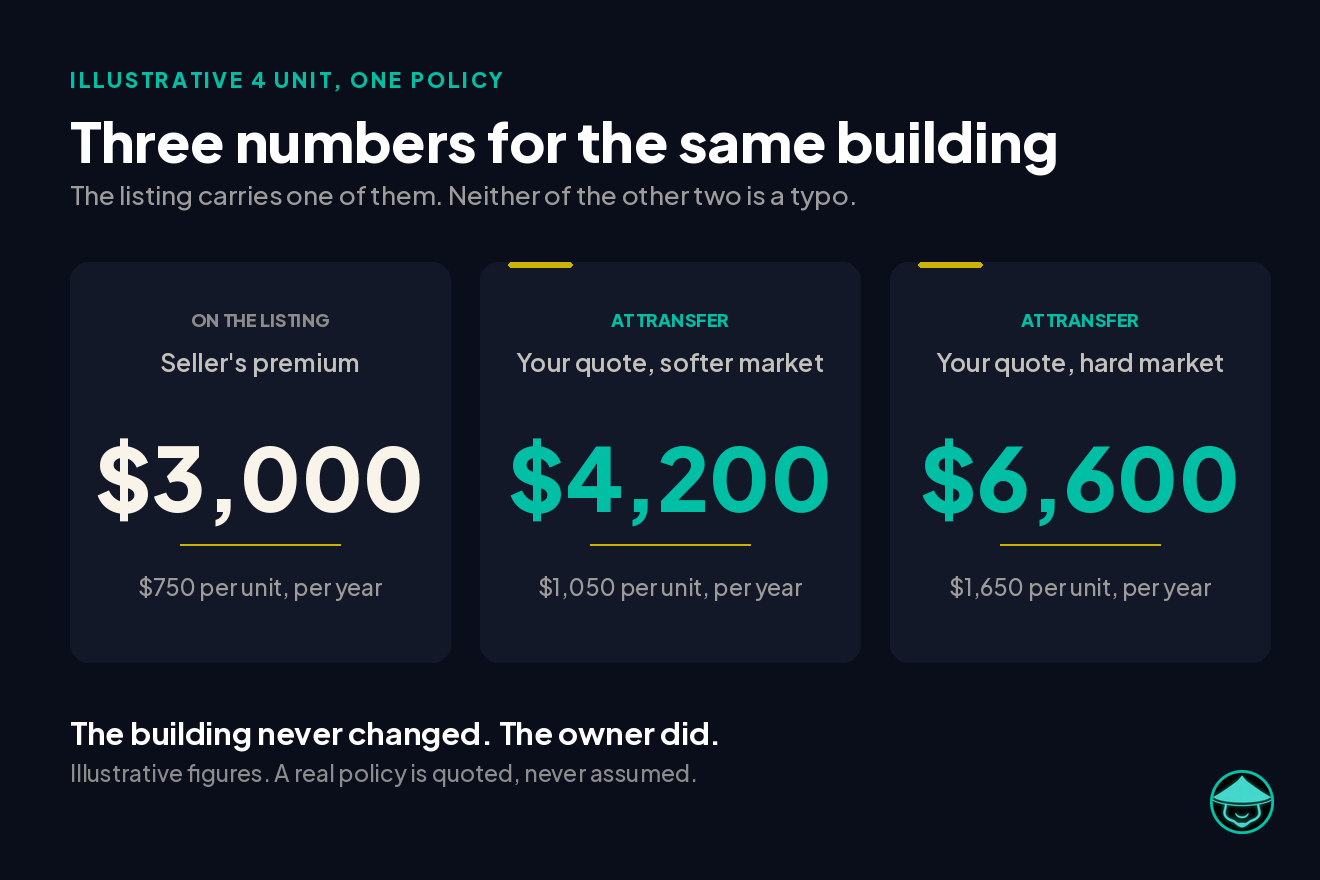
The insurance figure on a listing is the seller's premium. It is a fact about the seller, not a forecast for you. Policies reprice when a building changes hands, so your real number usually arrives after you have already committed to a price. On the illustrative 4 unit this blog has been walking, the seller carried 3,000 dollars. The quote at transfer came in at 4,200. A harder market quotes the same building at 6,600. That one line takes the repriced deal from a 1.25 DSCR to 1.18. Cash flow survives. The loan does not. And in 2026 the reset is not reliably upward, which is why a rule of thumb no longer substitutes for a quote.
Why is the insurance number on a listing wrong for you?
It is the seller's premium, not your quote. The figure on a listing or a broker's pro forma is what the current owner pays today. They often locked that rate years ago, and it has drifted since, if it has moved at all.
When you buy, the policy does not transfer at the seller's rate. The property is re-underwritten. The carrier prices it against today's replacement cost, the building's claims history, and you as the new owner. The number that comes back can look nothing like the line on the listing.
This is the quiet trap in almost every beginner underwrite. You trust the expense column because it came from the seller, and the one line most likely to move against you is the line you copied without checking. It sits alongside the other five lines a listing leaves out, and it is the only one where the sale itself is what triggers the change.
How far can that one line actually move?
Far enough to stop being a rounding error. Here is the building this blog has already corrected once and financed twice.
The deal, illustrative. A 4 unit listed at 625,000 dollars. Four units at 1,600 dollars a month, so 76,800 dollars of gross scheduled rent. When we corrected the listing's expense column, the insurance line went from the seller's 3,000 dollars to a quote of 4,200 at transfer. All figures here are illustrative.
That 4,200 was the friendly outcome. It is 1,050 dollars per unit per year, and it is the number the earlier posts have been carrying. A harder market quotes the same building at 6,600 dollars, or 1,650 per unit. Same roof. Same rent roll. Same year.
Neither number is exotic. Federal Reserve data show insurance rising from 1.95 percent of multifamily revenue in 2000 to 4.78 percent by 2024, and national operators are now budgeting a few hundred dollars more per unit than they were. In the hardest markets, per-unit costs run well past 1,200 dollars. The spread between a soft quote and a hard one on the same asset is wide, and nothing on the listing tells you which side you are on.
What does the reset do to a deal you already repriced?
It breaks the loan before it dents the cash flow. That order matters, because cash flow is the number most buyers watch and DSCR is the number that decides.
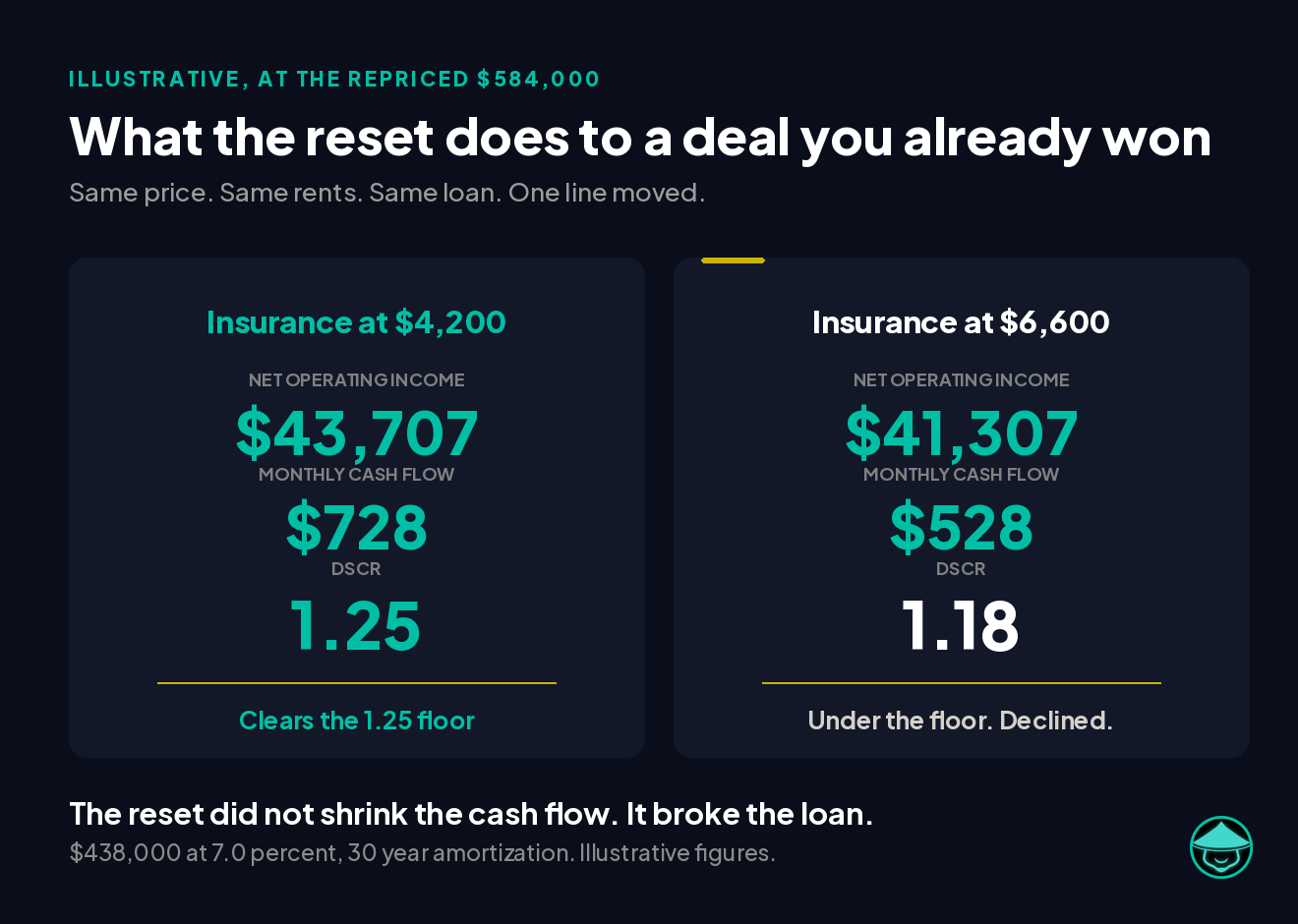
Pick the deal back up where the underwriting post left it. Correcting six missed lines took net operating income from 62,800 dollars to 43,133, and an advertised 10 percent cap to a real 6.9. At the asking price the deal still cleared 476 dollars a month and was declined anyway, on a 1.15 DSCR against a 1.25 floor. Solving backward from that floor gave a price that works: 584,000 dollars. At that price the deal produces 43,707 dollars of net operating income, a 1.25 DSCR, and 728 dollars a month.
Now swap the insurance line. Hold the price at 584,000 dollars, hold the rents, hold the loan at 438,000 dollars on a 7.0 percent, 30 year amortization. Move insurance from 4,200 dollars to 6,600 and nothing else.
Net operating income falls to 41,307 dollars. Monthly cash flow falls to 528. Still positive. You would look at that number and feel fine.
DSCR falls to 1.18. Back under the floor. Declined.
You corrected six lines. You solved backward from the lender's requirement. You negotiated 41,000 dollars off the ask and you earned every dollar of it. One line you did not quote takes the whole thing back, and it does it quietly, because the metric you were watching still looks healthy.
What price survives the reset?
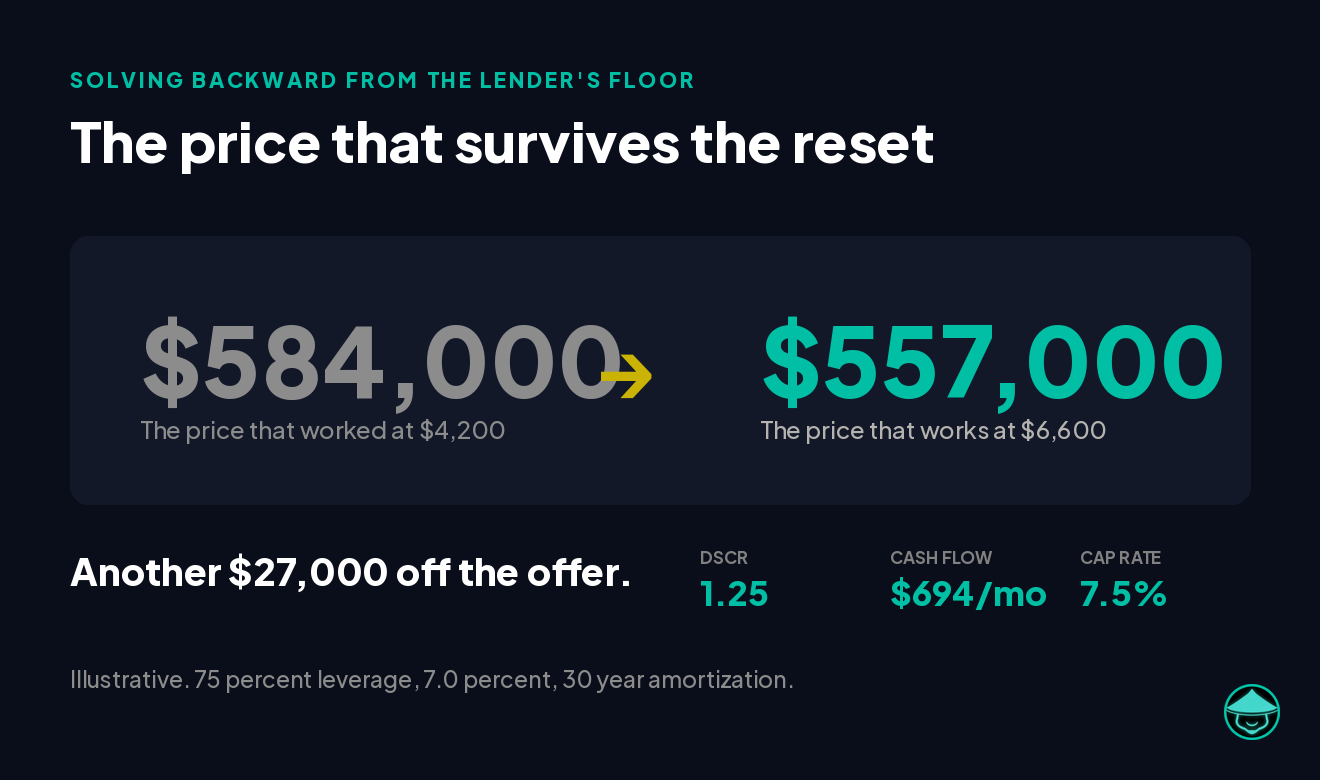
557,000 dollars on this building. Another 27,000 off the offer. The method is the same one that produced the 584,000 in the first place. Solve backward from the lender's floor rather than forward from the seller's hope.
At 557,000 dollars the taxes reassess lower, so net operating income lands at 41,685. A 75 percent loan is 417,750 dollars, and annual debt service is 33,350. DSCR clears at 1.25, monthly cash flow is 694 dollars, and the cap rate still reads 7.5 percent.
So the answer is not to walk. It is to find out early enough that the number is a negotiation instead of a surprise. A quote in week one is a lever. The same quote in week six is a retrade, and retrades are how buyers lose sellers.
Is insurance still going up in 2026?
Not everywhere, and that is the harder problem. The run-up was real. A Federal Reserve survey of multifamily owners found premiums rising 14 percent from 2021 to 2022, 22 percent the year after, and 45 percent from 2023 to 2024, leaving 2024 premiums at roughly double 2021.
2026 has split. Well-performing properties outside catastrophe-exposed regions are seeing renewals come in flat to slightly down, while higher-risk regions are still climbing. Some California carriers approved for rate increases are cutting rates instead, competing for share. Meanwhile liability coverage keeps trending up, deductibles stay higher than they were, and lenders are asking for coverage terms the market does not always want to write.
So the useful takeaway is not that insurance is expensive. It is that the number is no longer predictable from a national trend. A direction you could guess at. A reset you have to ask for.
What actually drives your quote is the building, its age, its construction, its claims history, the replacement cost the carrier assigns it, and where it sits. None of that is on the listing either.
What do you do about it before you write the offer?
Quote it, then underwrite on your number. Five moves, in order.
Quote it early. Send the address to an insurance broker the day a deal looks serious. A real quote takes a day or two, not a week, and it costs nothing.
Ask for the loss run. The property's claims history drives the premium more than the age of the roof does. Recent water or roof claims will show up in your quote, and the seller's loss run tells you before the carrier does.
Ask what replacement cost they are using. Carriers have been revaluing buildings to current construction costs, and a revaluation can move a premium without any change to the building.
Underwrite on the quote, not the listing. If you do not have a quote yet, stress the seller's number upward and run the deal on that. An estimate you chose beats a number you inherited.
Re-run DSCR, not just cash flow. This is the move nobody makes you do. Cash flow tells you whether the building feeds you. DSCR tells you whether the bank believes it. An insurance reset can leave the first one intact and still take the loan.
What does this say about the rest of the expense column?
A listing describes the seller's ownership, not yours. Insurance is the clearest case, because the sale itself is what triggers the reprice. The same logic runs through the whole expense column. Property taxes reassess on the sale in most jurisdictions. Management costs whatever it costs, whether or not you plan to do it yourself. Reserves depend on the age of the roof and the mechanicals, not on whether the seller funded them.
The number on the page is a claim. Your job is to sort the claims that are also facts for you from the ones that expire the day you take the keys.
Worked example, illustrative
| Seller's premium on the listing | $3,000 |
| Your quote at transfer, softer market | $4,200 |
| Your quote at transfer, hard market | $6,600 |
| NOI at $584,000, insurance $4,200 | $43,707 |
| NOI at $584,000, insurance $6,600 | $41,307 |
| Monthly cash flow | $728 to $528 |
| DSCR | 1.25 to 1.18 |
| Price that restores a 1.25 DSCR | $557,000 |
Illustrative 4 unit, four units at 1,600 dollars, the same building corrected in the underwriting post and financed in the DSCR post. 75 percent leverage at 7.0 percent on a 30 year amortization. Insurance is the only line changed between the two runs. Premiums vary by building, claims history, and location far more than by any national average. Quote your own policy before you underwrite anything.
Frequently asked
Does insurance really reset when I buy a property?
Yes. The seller's policy does not transfer to you at the seller's rate. The building is re-underwritten and priced for you as the new owner, against today's replacement cost and its claims history. Your premium can land well above the line on the listing, and you usually learn the real number after you have already agreed on a price.
How much should I budget for insurance on a small multifamily in 2026?
There is no reliable national number, because the premium depends on the building, its age, its construction, its claims history, and its location. On the illustrative 4 unit in this piece, the same building quotes anywhere from 1,050 to 1,650 dollars per unit per year depending on the market. Get an actual quote before you make the offer rather than trusting a rule of thumb.
Can an insurance quote actually kill a deal that cash flows?
Yes, and it usually kills the loan before it kills the cash flow. On the illustrative deal above, a 2,400 dollar increase left monthly cash flow positive at 528 dollars and pushed DSCR from 1.25 to 1.18, under a typical 1.25 lender floor. Cash flow and DSCR are different tests, and they fail at different times.
When should I get an insurance quote in the buying process?
The day the deal looks serious, and always before you write the offer. A quote in week one is negotiating leverage. The same quote in week six is a retrade, which is the fastest way to lose a seller you had already convinced.
If premiums are flattening in 2026, why would my quote still come in high?
Because a flattening market prices renewals, not transfers. The seller's premium reflects a policy written years ago on an older valuation, and your quote reflects today's replacement cost and today's terms. A market can be flat year over year and still hand a new buyer a much larger number than the outgoing owner was paying.
Where these numbers come from
Market context was checked in July 2026 against Federal Reserve and industry reporting. The deal and every figure derived from it are ours, and are illustrative. Premiums vary widely by building and location. Get your own quote.
Rising property insurance costs stress multifamily housing
Premium Pulse, national multifamily insurance cost acceleration
Why insurance costs are no longer high all over
Mainstream insurers squeamish about risk in multifamily
Senjo is AI underwriting for small multifamily deals. Fernando, its founder, has owned seven properties across three states over twenty years, all while employed full time. He holds two single family rentals today and is working toward his first small multifamily deal, building the tool he needed when he got stuck between the two.