The Explainer
DSCR loan or conventional loan for your first small multifamily?
Fernando, founder of Senjo · 8 min read
TL;DR
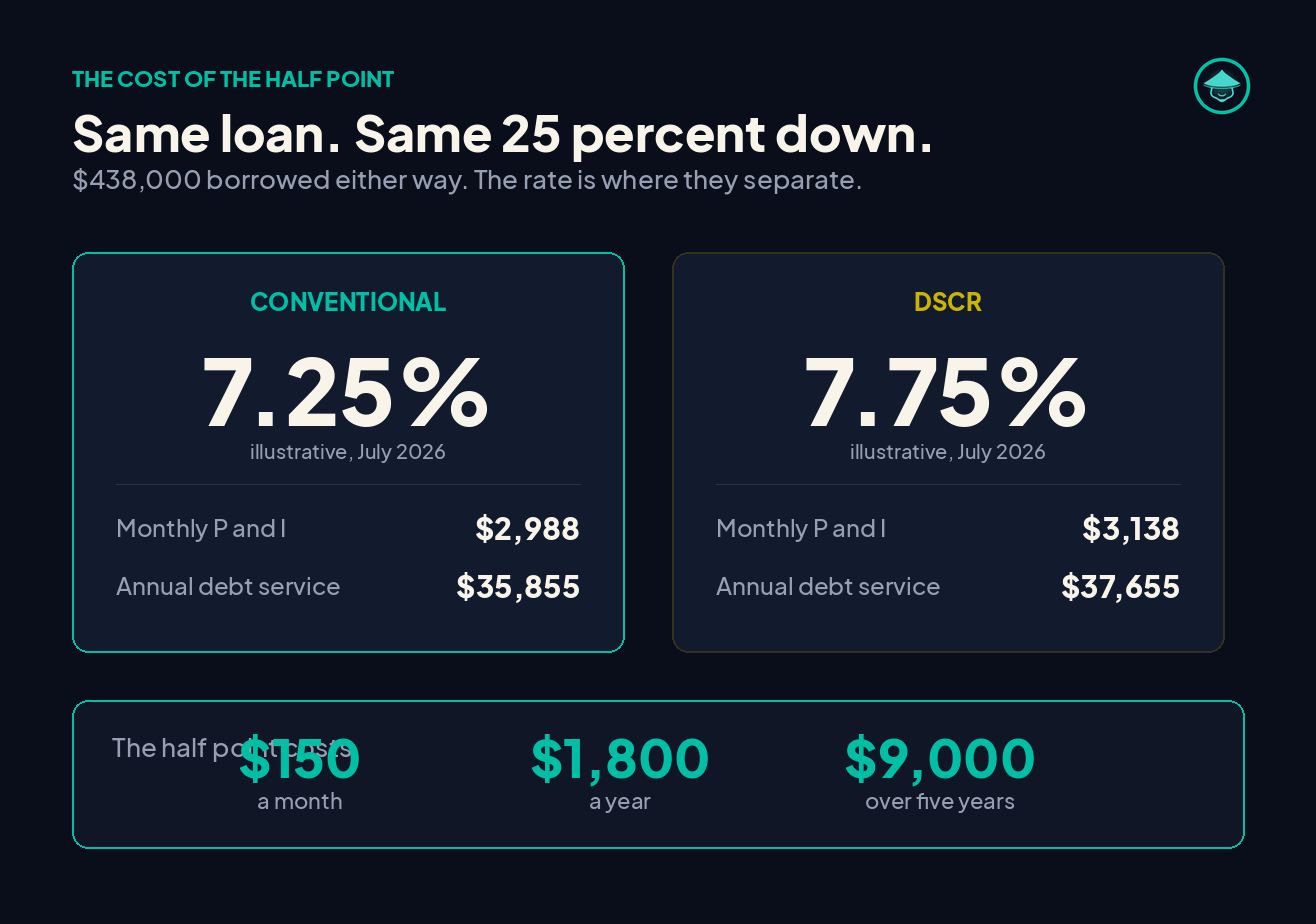
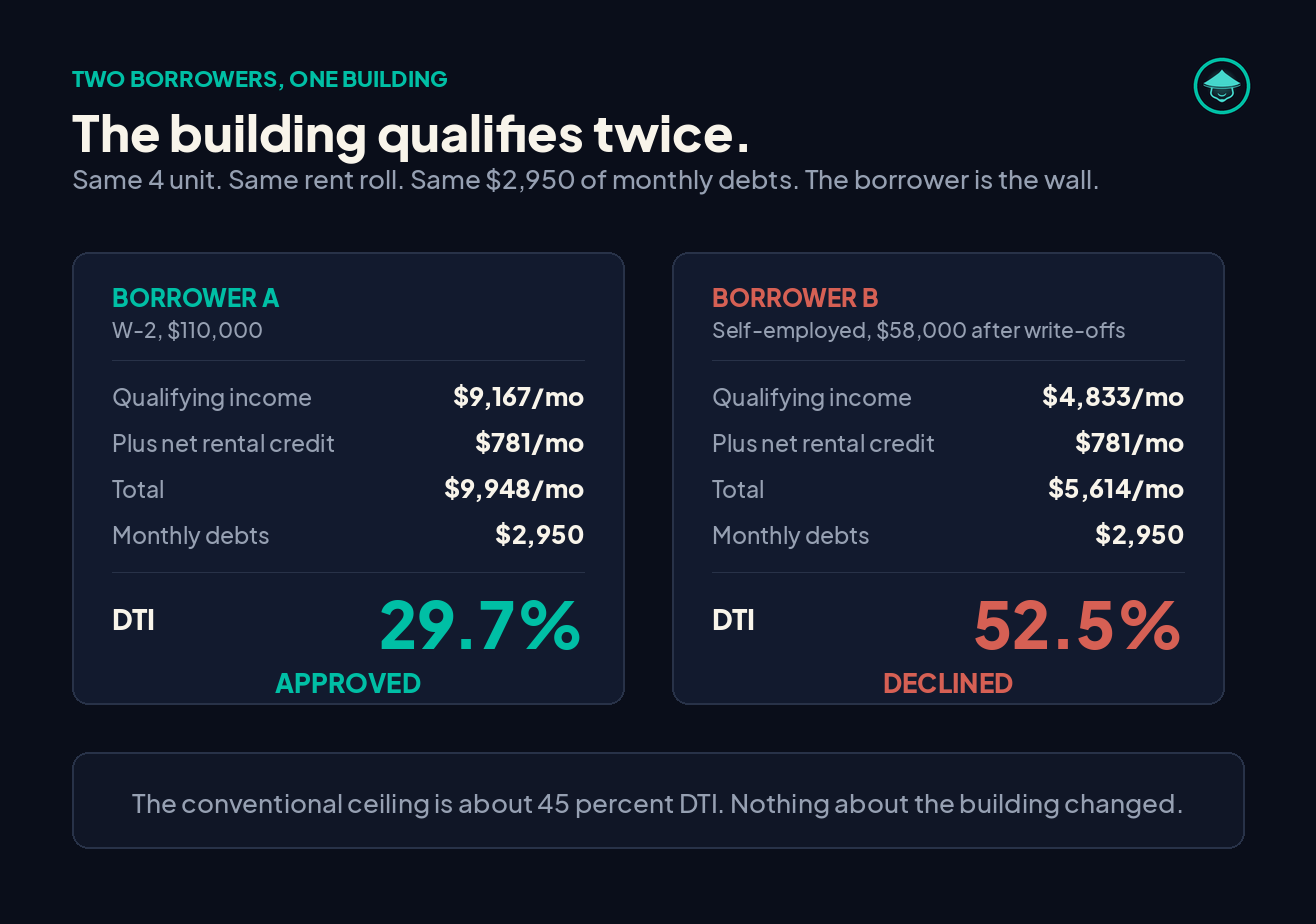
Conventional underwrites you. DSCR underwrites the building. That is the whole fork. Conventional is cheaper, about half a point in July 2026, which on one illustrative 4 unit is 150 dollars a month and 1,800 a year. So conventional is the default answer, until your income will not document. Then DTI kills a deal the building already passed. On the same illustrative 4 unit, a W-2 borrower cleared conventional at a 29.7 percent DTI. A self-employed borrower with the same debts and the same building came in at 52.5 percent and was declined. The catch nobody leads with: a residential DSCR lender divides gross rent by PITIA. That deal scored a 1.54 with the lender. Its real coverage was 1.16.
What is the actual difference between a DSCR loan and a conventional loan?
They ask different questions. A conventional loan asks whether you can carry the debt. A DSCR loan asks whether the building can. That sounds like a technicality. It is the entire decision.
A conventional investment property loan, the Fannie and Freddie kind, runs your W-2s, your tax returns, your credit, and every monthly obligation you already carry. The building is collateral. You are the borrower.
A DSCR loan runs the rent roll against the payment. No income documentation. No debt to income ratio. The building is the borrower, and you are the guarantor standing behind it.
Everything else that gets written about these two loans is downstream of that one difference.
Which one is cheaper, and by how much?
Conventional, and by roughly half a point. In July 2026, investment property conventional rates are running about 7.1 to 7.6 percent, with another 0.125 to 0.25 tacked on for a 2 to 4 unit. DSCR loans price about 0.50 to 1.50 higher.
Both want 25 percent down on a 4 unit, so the loan amount is usually identical. The rate is where they separate. On a 438,000 dollar loan, conventional at 7.25 percent runs 2,988 dollars a month in principal and interest. DSCR at 7.75 percent runs 3,138. That half point costs 150 dollars a month. It is 1,800 a year, and 9,000 over the first five years, and it comes straight out of cash flow.
There is a second cost that does not show up in the rate. Many DSCR loans carry origination points and a prepayment penalty, commonly a step down over the first three to five years. If you plan to refinance out in year two, price that penalty before you sign, not after.
So the honest starting position is this. Conventional is the cheaper loan. Take it if you can get it. The rest of this piece is about the moment you cannot.
So when does conventional actually stop working?
When your income will not document. Not when the deal is bad. The deal can be fine and you can still be declined, because the number that kills you is your debt to income ratio, and DTI has nothing to do with the building.
Fannie counts only 75 percent of the rent. The other 25 percent is held back as a built in cushion for vacancy and upkeep. So a building renting for 6,400 dollars a month shows up in your file as 4,800.
The full payment counts against you. Principal, interest, taxes, insurance, and any association dues. All of it, at 100 percent.
Then the two get netted. If 75 percent of the rent covers the payment, the surplus is added to your income. If it does not, the shortfall is added to your debts, and the deal starts eating your borrowing capacity instead of building it.
The ceiling is around 45 percent. For a 2 to 4 unit investment property, conventional guidelines generally want DTI under 45 percent, with a 680 plus credit score and cash reserves on top.
A strong yielding building gets through that gauntlet easily. A borrower whose tax returns show less than their bank account does, does not.
What happens when you run the same deal past two different borrowers?
The building qualifies both times. The borrower is the wall. Same property, same rent roll, same price. One gets a conventional loan. One does not.
The deal, illustrative. The 4 unit from the underwriting piece, repriced. 584,000 dollars. Four units at 1,600 dollars a month, so 76,800 dollars of gross scheduled rent. After the corrected read, net operating income is 43,707 dollars. All figures here are illustrative.
The financing, illustrative. 25 percent down, so 146,000 dollars in cash and a 438,000 dollar loan. Taxes reassessed at the purchase price come to 8,176 dollars. Insurance repriced at transfer is 4,200. That makes the conventional PITIA 4,019 dollars a month. Seventy five percent of the 6,400 dollar rent roll is 4,800. So the building throws off a net rental credit of 781 dollars a month before we even look at the borrower.
Borrower A. W-2, 110,000 dollars. Primary residence payment 2,300 dollars. Car, student loan, and card minimums 650. Credit 740. Qualifying income of 9,167 dollars a month, plus the 781 rental credit, against 2,950 dollars of monthly debts. DTI 29.7 percent. Approved, comfortably. Take the conventional loan, take the 7.25 percent, and stop reading.
Borrower B. Self-employed, same building, same debts. Bills more than Borrower A. Writes off a truck, a home office, phone, mileage, and equipment. The tax returns net out at 58,000 dollars, and 58,000 is the only number the lender is allowed to see. Qualifying income of 4,833 dollars a month, plus the same 781 credit, against the same 2,950 of debts. DTI 52.5 percent. Declined, over the 45 percent ceiling by more than seven points.
Nothing about the building changed. The rent did not change. The cap rate did not change. The write-offs that lowered his tax bill in April are the same write-offs that cost him the loan in July. He is not a worse investor than Borrower A. He is a worse file.
That is the fork. Borrower A does not need a DSCR loan. Borrower B has no other door.
What is the DSCR the lender is actually calculating?
Gross rent divided by PITIA. Not net operating income divided by debt service. This is the single most misread number in investor financing, and it is the reason a DSCR approval is not the same thing as a good deal.
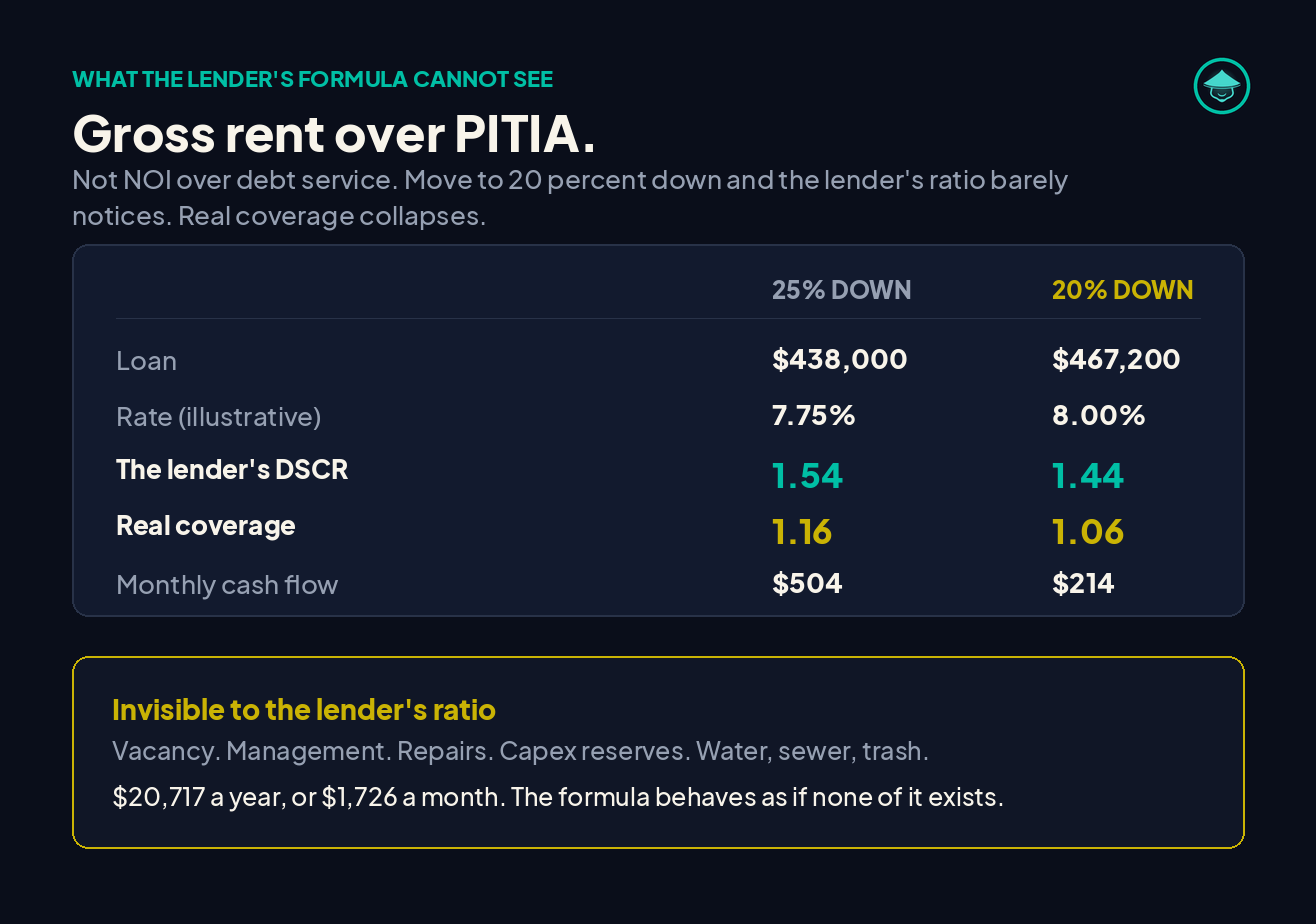
For residential 1 to 10 unit properties, a DSCR lender takes the full gross rent and divides it by principal, interest, taxes, insurance, and association dues. That is it. Look at what that formula does not contain. No vacancy. No management. No repairs. No capex reserves. No water, sewer, or trash. On the illustrative 4 unit, those lines are 20,717 dollars a year, or 1,726 a month, and the lender's ratio behaves as if none of them exist.
So the same deal produces two very different numbers. Gross rent of 6,400 dollars a month over a PITIA of 4,169 gives the lender a DSCR of 1.54, which clears every floor in the market, and those typically sit between 1.0 and 1.25. The lender is delighted. Run the honest ratio instead, 43,707 dollars of net operating income over 37,655 dollars of annual debt service, and real coverage is 1.16. Thinner than it looked, and thinner than the conventional borrower's 1.22.
The loan approved. The deal still has to be true.
This is where the down payment question gets dangerous. Some DSCR lenders will go to 20 percent down for a rate bump. On this deal that frees up 29,200 dollars of cash and looks like a smart use of leverage. The lender's ratio barely moves, from 1.54 to 1.44, and stays comfortable, because the formula it uses cannot see the 1,726 dollars a month it left out. Real coverage falls to 1.06. Monthly cash flow drops 58 percent, from 504 dollars to 214. One vacant unit for two months and the building is feeding on your savings.
Nothing in the approval will warn you. The approval was never measuring that.
So how do you actually pick?
Run four checks, in this order. The pick usually makes itself by the second one.
1. Can you document the income? Two years of W-2s or clean tax returns, DTI under 45 percent after the 75 percent rental credit, 680 plus credit. If yes, take the conventional loan. It is half a point cheaper and there is no prepayment penalty to trip over. Do not reach for a DSCR loan because it sounds like the sophisticated choice.
2. Are you self-employed, commission based, or heavily written off? Then your qualifying income is not your real income, and DTI will decide this for you. DSCR is not a compromise here. It is the correct instrument, and the half point is what it costs to be judged on the building instead of the tax return.
3. How many doors do you want in three years? Conventional caps out at 10 financed properties, and the reserve requirements get heavier as you stack them. DSCR loans do not count against that limit, and they are typically written to an LLC rather than to you personally. If the plan is one building, this does not matter. If the plan is five, it decides your first one.
4. Does the deal survive the honest ratio? Whichever loan you use, rebuild DSCR yourself as net operating income over debt service before you sign. If the lender's 1.54 is really a 1.16, you want to know that on your own spreadsheet and not in month seven.
Check four is the one nobody makes you do. It is also the only one that protects you, because the other three are questions the lender is asking about their risk, and the fourth is the only question about yours.
One more, if the building is bigger than four units. Neither loan in this piece is on the table. Conventional closes above four units, so the choice becomes a commercial bank loan, a DSCR loan written to the asset, or a seller carry sitting behind one of them. That last one is its own arithmetic, and it is worth seeing what a stacked seller carry does to the monthly before you ask for one.
One honest caveat
Every rate in this piece is illustrative and dated. It is July 2026, and the conventional to DSCR spread has run anywhere from 0.50 to 1.50 points depending on the borrower, the ratio, and the lender. Half a point is a reasonable midpoint. It is not a quote.
DSCR terms vary more than conventional terms do, because there is no Fannie rulebook holding them in line. Floors, points, prepayment penalties, and reserve requirements move lender to lender. Get two or three real quotes before you decide, and compare the full cost, not the headline rate.
Tax reassessment rules vary by state and by county. Confirm yours with the county assessor before you underwrite anything.
And the numbers above are one building. Change the yield and the answer changes with it. What does not change is the order of the questions.
Worked example, illustrative
| Gross monthly rent | $6,400 |
| PITIA | $4,169 |
| The lender's DSCR (gross rent / PITIA) | 1.54 |
| What that formula cannot see | - $1,726/mo |
| NOI, corrected | $43,707 |
| Annual debt service | $37,655 |
| Real coverage (NOI / debt service) | 1.16 |
| Monthly cash flow | $504 |
Illustrative 4 unit at 584,000 dollars, 25 percent down, a 7.75 percent DSCR loan on a 30 year amortization. The lender's ratio and the honest ratio are run on the same deal in the same month, and they disagree by 0.38. The gap is vacancy, management, repairs, capex reserves, and utilities, 20,717 dollars a year the lender's formula never asks about. Lender formulas and floors vary. Rebuild the ratio yourself before you sign.
Frequently asked
Is a DSCR loan harder to get than a conventional loan?
Not harder, different. A DSCR loan skips income documentation and DTI entirely, which makes it easier for a self-employed or heavily written-off borrower and effectively no easier for a strong W-2 borrower. What it asks for instead is a stronger building, a 20 to 25 percent down payment, and usually a 680 plus credit score. You trade a document check for a rate premium of roughly 0.50 to 1.50 points.
Why did my DTI kill a rental loan when the property cash flows?
Because conventional guidelines only credit 75 percent of the gross rent while counting 100 percent of the new payment, then measure the result against your existing debts. If 75 percent of the rent does not cover the full payment, the shortfall is added to your monthly obligations. A building can throw off real cash and still push your ratio over the roughly 45 percent ceiling, especially if your qualifying income is lower than your actual income.
Does a DSCR loan count vacancy and management?
No. A residential DSCR lender divides gross monthly rent by the full payment. Vacancy, management, repairs, capex reserves, and utilities are not in the formula. On the illustrative 4 unit in this piece, those lines totaled 20,717 dollars a year. A 1.25 DSCR on a lender's worksheet does not mean the property cash flows once you own it. Rebuild the ratio yourself as net operating income over debt service.
How much more does a DSCR loan actually cost?
On a 438,000 dollar loan, moving from 7.25 percent to 7.75 percent costs about 150 dollars a month, 1,800 a year, and 9,000 over five years. Add origination points and a possible prepayment penalty on top. That is the price of being underwritten on the building instead of on your tax return, and for the right borrower it is worth paying.
Can I use a conventional loan for a 4 unit rental?
Yes. A 2 to 4 unit investment property is conventionally financeable at 25 percent down, subject to a DTI under roughly 45 percent, a 680 plus score, and cash reserves. The ceiling is the financed property limit, which is 10. Most first-time small multifamily buyers should start here and only move to DSCR when documentation or scale forces the change.
Where these numbers come from
Rates and guidelines were checked in July 2026 against current lender and mortgage-market reporting. The deal, the borrowers, and every figure derived from them are ours, and are illustrative. Rates move. Verify before you underwrite.
Investment property mortgage rates
How residential DSCR is calculated
Senjo is AI underwriting for small multifamily deals. Fernando, its founder, has owned seven properties across three states over twenty years, all while employed full time. He holds two single family rentals today and is working toward his first small multifamily deal, building the tool he needed when he got stuck between the two.