The One Number
What DSCR do lenders require for a small multifamily loan?
Fernando, founder of Senjo · 6 min read
TL;DR
DSCR is net operating income divided by annual debt service. It is the one number most lenders use to decide whether your loan works, and the common bar on a small multifamily deal is 1.25x. Below that, the loan shrinks or the terms harden. The number is moved as much by your financing as by the property, so the same building can clear on one loan and fail on another. Run the deal under each structure before you decide.
What is DSCR?
DSCR is net operating income divided by annual debt service, which sounds technical and is actually simple. Think of it like a household budget. A family that brings home exactly their rent each month has no room, so one surprise bill sinks them. A family that brings home 25 percent more than the rent has a cushion.
DSCR is that same idea for a building. Take a 6 unit that earns $52,000 a year after operating expenses. If the loan costs $41,500 a year, the building earns about 1.25 times its payment, so its DSCR is 1.25x.
NOI is the income after expenses and before the loan, the same number you use for a cap rate. Annual debt service is twelve months of principal and interest. One divided by the other is the whole formula.
One caution before you go further. That is the honest ratio, and it is the one you should run. A residential DSCR lender often computes its own version on gross rent over the full payment instead, which flatters the number. It is worth knowing which of the two you are looking at.
What DSCR do lenders require?
Most lenders want at least 1.25x on a small multifamily loan, and many will not go below 1.20x. The number is really a measure of cushion. Back to our 6 unit at 1.25x: it can lose a unit to vacancy for a couple of months, or absorb a surprise repair, and still cover the mortgage. The same building at 1.0x has no room, so one vacant unit means writing a personal check to make the payment.
That is the risk the lender is pricing. When a deal comes in under the bar, they rarely say no outright. They lend less, so you bring more cash, or they raise the rate, which makes the payment bigger and pushes the DSCR down again. The deal has to clear the bar on the building's own income.
What moves your DSCR?
Two things, and the surprising one is that the building is only half of it. The first lever is NOI, which you lift with higher rents or lower expenses. The second is the loan payment, set by the loan amount, the interest rate, and how many years it is stretched over. That second lever is why the same building can pass on one loan and fail on another.
Keep our 6 unit's $52,000 fixed and change nothing about the property. On an 8 percent loan the payment runs about $45,800 a year, a 1.14x DSCR, under the bar. Move to a 7 percent loan and the payment drops to about $41,500, a 1.25x DSCR, over the bar. Same rents, same expenses, same building. The financing decided the number.
How do you check it in 60 seconds?
Divide the property's NOI by twelve months of the loan payment, and read the result against 1.25x. Our 6 unit at $52,000 over a $41,500 payment lands at 1.25x, so it clears with no room to spare.
Land at 1.25x or higher and you clear the common bar. Land between 1.0x and 1.25x and the building covers the loan but not by enough for most lenders, so expect a smaller loan or harder terms. Land below 1.0x and the income does not cover the payment at all, which no return target you set can fix.
Run this before you fall for a deal, because the financing layer is where an otherwise fine property quietly stops working.
Where does Senjo fit?
Senjo runs this for you, which is the point. It takes the property's NOI and tests the DSCR across each financing structure at once, then shows the reasoning behind every number instead of just handing you a verdict. That is how the basics stop being intimidating. You see why a deal clears or comes up short, not only whether it did.
I am building it as I work toward my own first small multifamily deal, because a number you cannot see into is a number you cannot trust, and I wanted one that always shows its work.
What do you do when the DSCR comes up short?
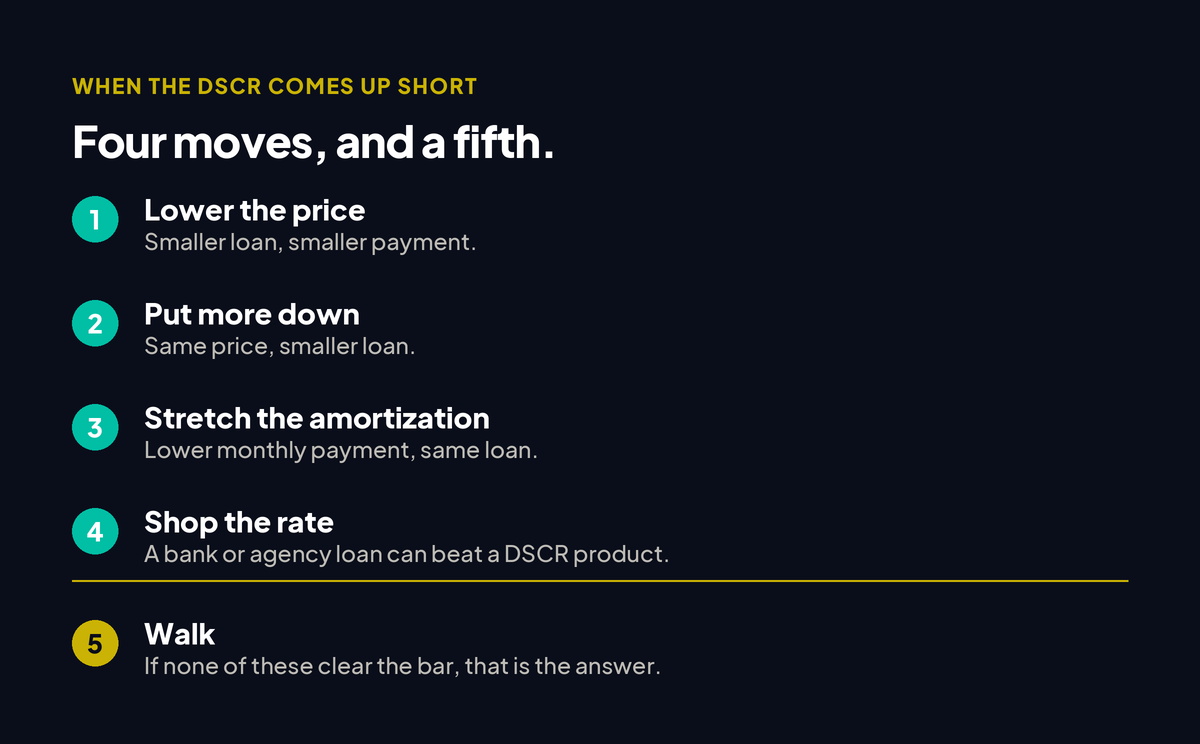
You have four moves, and a fifth.
Lower the price or put more down, and the loan and the payment shrink with it.
Stretch the amortization, and the monthly payment drops on the same loan.
Shop the rate, because a bank or agency loan can beat a DSCR product and a lower rate lifts the number directly.
Run the deal under each and see which one carries the DSCR over the bar.
The fifth move is to walk, and on a deal that only works with financing you cannot actually get, walking is a result, not a loss.
Worked example, illustrative
| NOI | $52,000 |
| DSCR loan, 8% / 30 yr, annual payment | $45,800 |
| DSCR on the DSCR loan | 1.14x |
| Bank loan, 7% / 30 yr, annual payment | $41,500 |
| DSCR on the bank loan | 1.25x |
Figures are illustrative and rounded. Same property, same NOI. A one point difference in rate moved the number from short of the 1.25x bar to clearing it. The spread between a DSCR product and a bank loan is set by the lender and the borrower, and has run anywhere from about half a point to a point and a half, so the full point here is one illustration, not a rule. Rates, terms, and lender minimums vary, so run your own.
Frequently asked
What is a good DSCR for a rental property?
Most lenders want at least 1.25x on small multifamily, and higher is safer. At 1.25x the property earns 25 percent more than the payment, which is enough cushion to survive a vacancy or a repair. Anything near 1.0x is too thin for most lenders and for most investors.
What is the difference between DSCR and cash flow?
DSCR is a ratio the lender uses to size the loan. Cash flow is the dollars left in your pocket after the payment. A deal can clear a 1.25x DSCR and still leave thin monthly cash flow, so check both. The lender cares about the ratio. You care about the dollars.
Is a 1.0 DSCR break-even?
Yes. At 1.0x the net operating income exactly equals the debt service, so there is no margin. One vacancy or one repair tips it negative. That is why lenders want a buffer above it.
Does the mortgage rate change my DSCR?
Yes, directly. DSCR uses the loan payment, so a higher rate, a shorter amortization, or a larger loan all raise the payment and lower the DSCR. The same property can clear the bar on one loan and miss it on another.
DSCR loan or conventional, which gives the better DSCR?
Neither by default. The one with the lower payment produces the higher DSCR, and conventional usually prices about half a point cheaper. But the real question is not which loan gives the better ratio. It is which loan you can qualify for, and that is decided by whether your income documents, not by the deal.
Senjo is an AI sensei for solo multifamily investors. Fernando, its founder, owns two single family rentals and is working toward his first small multifamily deal, building the tool he needed when he got stuck between the two.