The Explainer
What is a real cap rate, and why is the one in the listing wrong?
Fernando, founder of Senjo · 6 min read
TL;DR
The cap rate in a listing is the advertised cap rate. It usually leans on best case rents, understates expenses, and prices the building on the seller's old property tax bill instead of the higher one a buyer inherits. Rebuild it yourself from the actual rent roll, a real vacancy factor, and full operating costs. On the illustrative 5 unit below, the real cap rate came in at 5.1 percent, not the 6.4 percent advertised.
What is a cap rate?
A cap rate is net operating income divided by price. In plain terms, it is the income a property earns in a year as a percentage of what it costs, before you bring a loan into the picture. If a building earns 30,000 dollars after expenses and the price is 600,000 dollars, the cap rate is 5 percent.
NOI is the income left after operating expenses and before the mortgage. Rent comes in. Taxes, insurance, repairs, management, utilities, and reserves come out. The mortgage payment does not belong in NOI, which is why two buyers who put down different amounts can read the same cap rate and see the same number.
Why is the cap rate in the listing usually wrong?
Because the listing cap rate is a marketing number, not an underwriting number. It exists to make the asking price look justified, so it is built from the most favorable version of every input.
It uses pro forma rents instead of the rents tenants actually pay. It assumes zero or token vacancy, as if a unit never turns. It drops line items, most often property management and reserves. And it prices the building on the seller's current property taxes, even though in many places the assessed value resets at sale, so the new owner's bill is based on the purchase price. Each move lifts NOI, and a higher NOI on the same price is a higher cap rate.
How do you rebuild the real cap rate in 60 seconds?
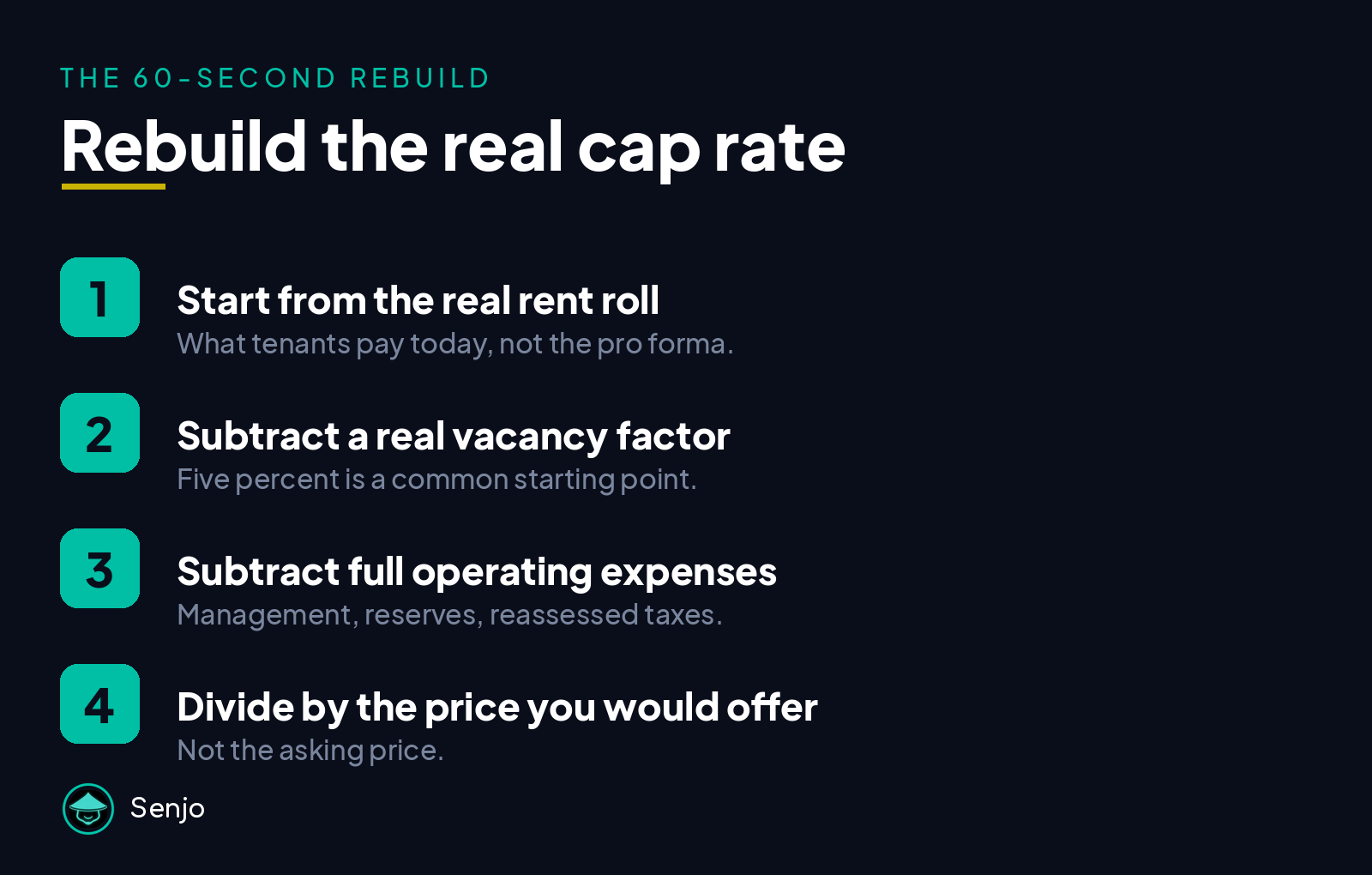
Take the actual numbers, not the pro forma ones, and run four steps.
Start from the real rent roll and annualize what tenants pay today. Subtract a real vacancy and credit loss factor, with five percent a common starting point and higher in a soft market. Subtract full operating expenses, including the three the listing usually drops: management, reserves for big ticket repairs, and the reassessed property taxes you will actually pay.
Then divide that NOI by the price you would actually offer, not the asking price. The output is the number the deal earns in your hands, not the seller's.
What size gap should make you walk?
The number to watch is not the size of the gap. It is whether the real cap rate still clears your return target after the rebuild. A deal advertised at 6.4 that rebuilds to 5.1 is not automatically a bad deal. It means you are being asked to pay a premium for the seller's optimism, so price your offer off the 5.1, not the 6.4.
If the building only works for you at a 6 percent real cap, the rebuild just told you your offer is below the ask, and roughly by how much. That is not a reason to freeze. It is the number you negotiate from.
The same math runs in reverse once you own it: as equity grows, watch your return on equity to know when to hold, refinance, or sell.
What does the rebuild look like on a real deal?
Here is the whole thing on one illustrative 5 unit listed at 750,000 dollars. The numbers are illustrative, chosen to show the mechanics, not a specific property. The listing advertised a 6.4 percent cap. A real vacancy factor took 4,000 dollars off the income the seller showed as fully occupied. The real expenses ran 5,750 dollars higher, once you add the management the seller self performs, the reserves the listing ignored, and the property taxes reassessed to the purchase price.
That is 9,750 dollars of NOI that was never going to show up, and it is the entire distance between a 6.4 and a 5.1. For the same rebuild run on a real listing all the way to a decision, see the walk on a 6 unit that advertised a 10 percent cap.
Worked example, illustrative
| Advertised NOI | $48,000 |
| Less real vacancy, 5% | - $4,000 |
| Less omitted expenses | - $5,750 |
| Real NOI | $38,250 |
| Real cap rate on $750,000 | 5.1% |
Figures are illustrative and rounded for teaching. The omitted expenses are management, reserves, and the reassessed property taxes a new owner inherits. Always run your own market vacancy, management, and reserve assumptions.
Frequently asked
What is the difference between a pro forma cap rate and a real cap rate?
A pro forma cap rate uses projected best case income, often with full occupancy and light expenses. A real cap rate uses the actual rent roll, a real vacancy factor, and full operating costs including management, reserves, and reassessed taxes. The pro forma number sells the deal. The real number underwrites it.
Should reserves be included in net operating income?
Yes, for underwriting. Roofs, systems, and turnover are real recurring costs even if they do not hit every month. Leaving reserves out is one of the most common ways a listing cap rate gets inflated.
Why does the property tax change when I buy?
In many places the assessed value resets at sale, so your tax bill is based on what you paid, not what the seller was paying. A long time owner can have a tax bill far below what a new buyer will owe. Always reprice the taxes to the purchase price before you trust the NOI.
Is a 5 percent cap rate good or bad?
There is no universal answer. A cap rate is only useful next to the market, the asset, and your cost of capital. The point of the rebuild is to know the real number before you make an offer.
Senjo is an AI sensei for solo multifamily investors. Fernando, its founder, owns two single family rentals and is working toward his first small multifamily deal, building the tool he needed when he got stuck between the two.