The Explainer
When should you sell a small multifamily property?
Fernando, founder of Senjo · 6 min read
TL;DR
Most owners think about selling in terms of price. The sharper question is return on equity: what the money trapped inside the property is actually earning right now. You have three moves, not one. Sell when your return on equity has fallen below what that money could earn in a better fit property, and a 1031 exchange can move it without a tax hit today. Refinance when the property is still a good hold but the equity is sitting idle. Hold when cash flow, location, and your timeline still line up. On the illustrative deal below, a 12 percent return in year one had quietly become 4.4 percent by year five, with nothing wrong at the building.
When should you sell a small multifamily property?
Sell when the equity trapped in the property is earning less than it could in a better fit asset, or when the property no longer matches your goal, your timeline, or your appetite for management. Price is the trigger most people watch. Return on equity is the number that should actually drive the call.
Return on equity means one thing: of all the money you have tied up in the property today, how much is it handing back to you each year? A property can be worth a lot on paper and still put very little of that value back in your pocket. That gap is the signal.
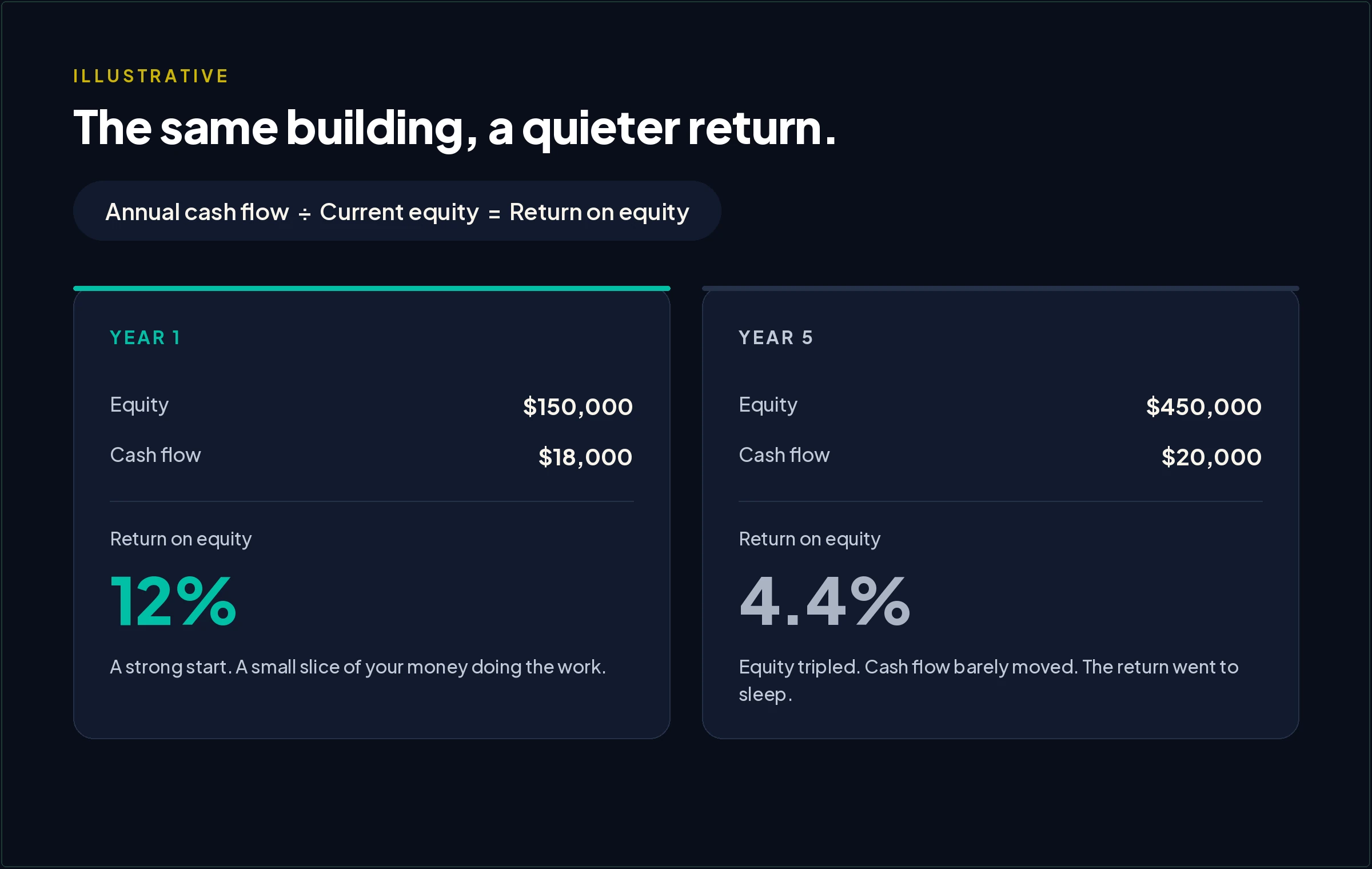
Here is how a good deal goes quiet. When you bought, a smaller slice of your money was doing the work. Years later the property is worth more and the loan is smaller, so a much bigger pile of your money is now locked inside it. But the rent did not climb at the same pace, so the same cash flow is now spread over a bigger pile. The return on that pile shrinks. Nothing went wrong at the building. The money just went to sleep. That is the case for a sale, and it is invisible if you only watch the sale price.
What are your three options: hold, refinance, or sell?
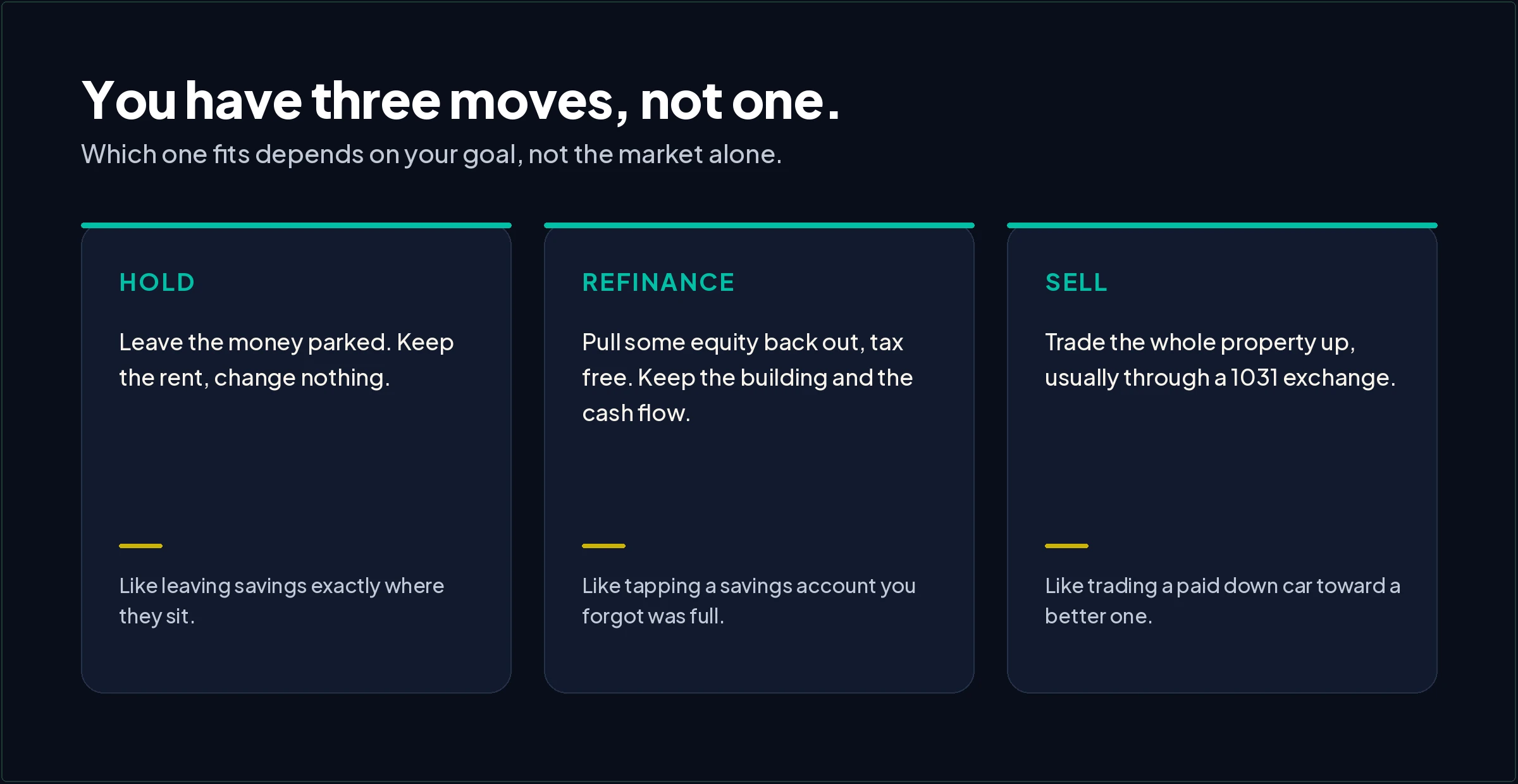
Most people think selling is a yes or no choice. It is not. You almost always have three moves, and the right one depends on your goal and your situation, not on the market alone.
Hold is the do nothing move. You keep the property and the monthly rent, and you change nothing. It is the most underrated option: if the cash flow still clears your floor and your return on equity is still competitive, doing nothing is often the correct call.
Refinance is the take some out move. A cash out refinance lets you borrow against the value the property has built up and pull some of that locked in money back out to put to work again, tax free, while you still own the building and still collect the rent.
Sell is the trade it in move. A sale, usually through a 1031 exchange, hands over the whole property and rolls all of that money into one that fits your goal better, with no tax bill at the time of sale. It resets everything, so it should clear the highest bar.
How do you know if your equity is stuck?
Divide your annual pre tax cash flow by your current equity. That is your return on equity. When you bought, that number was the same as your cash on cash return. Both start from net operating income, the same figure you rebuild for a real cap rate. As the property appreciates and the loan pays down, equity grows, and unless rents keep pace, return on equity quietly falls.
A low return on equity is the clearest signal that your money could be working harder somewhere else. Run it once a year. It takes two numbers you already have: this year's cash flow, and your equity, which is the current value minus the loan balance. If the result is well below what you could earn by redeploying that equity into a new deal, you have found a reason to look at refinancing or selling. If it is still healthy, you have just justified the hold.
When does refinancing beat selling?
Refinance when the property is still a good long term hold but too much of your equity is sitting idle. A cash out refinance pulls capital out tax free to redeploy, while you keep the asset, the cash flow, and the depreciation schedule. It beats selling when a sale would trigger taxes you would rather defer, or cost you a below market interest rate you want to keep.
The trade off is that a refinance raises your loan balance and your monthly payment, which lowers the cash flow on the property you kept. So the redeployed capital has to earn more than that drag costs you. When it does, you get the best of both: the original property keeps working, and the freed equity goes back to work in a second one.
When is selling the right call?
Sell when the property no longer fits, the return on equity is low, and a better fit asset exists to move into. A 1031 exchange lets you roll the entire gain into the next property without paying capital gains tax at the time of sale, as long as you follow the IRS timelines. Selling also makes sense when management has become a burden that outweighs the return, or when your goal has simply changed.
The mistake is selling into no plan. A sale without a target property, or at least a clear reason the cash is better off out of real estate, often just converts a working asset into idle cash and a tax bill. Sell toward something, not away from something.
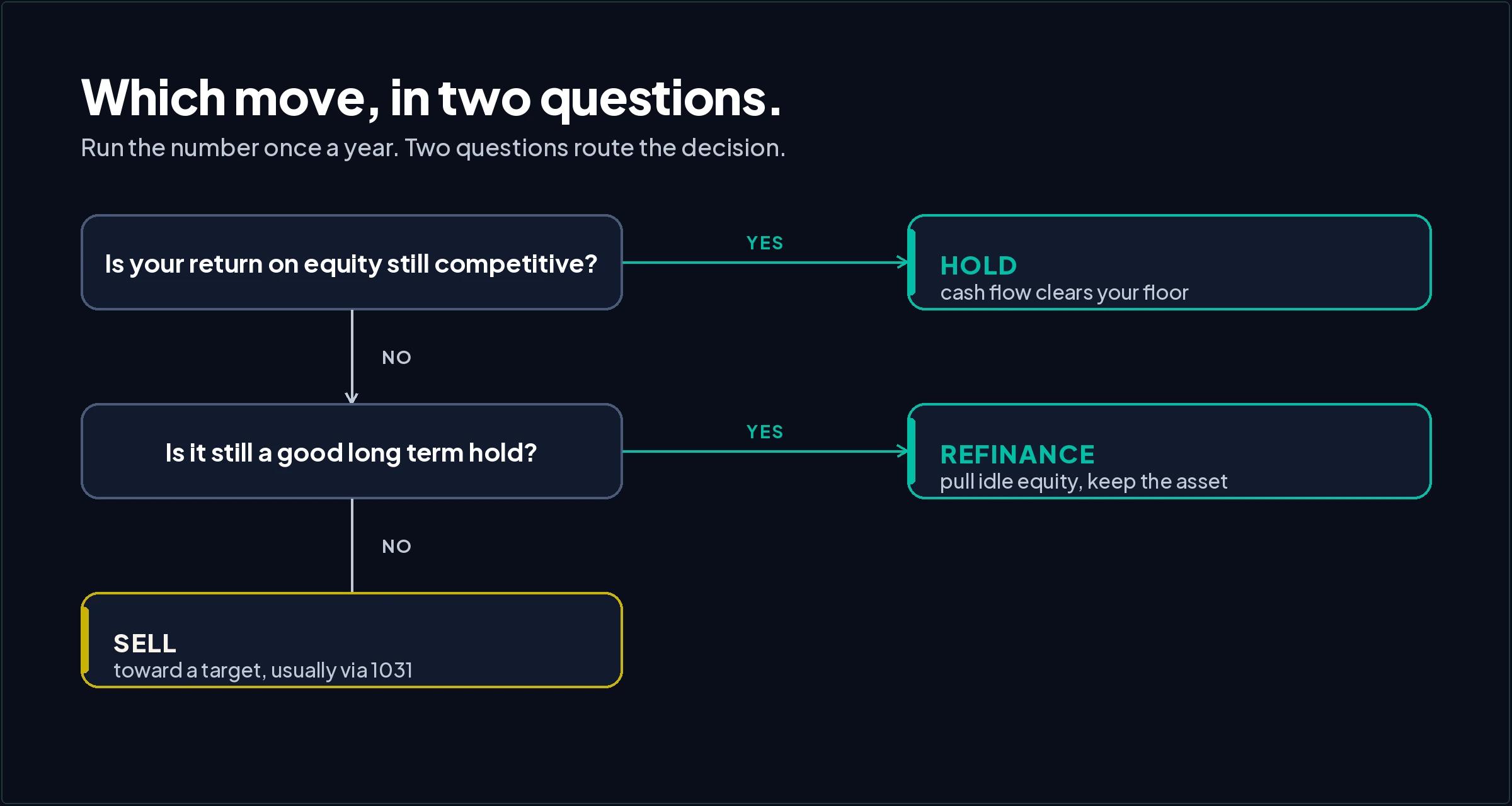
Put simply, the whole call reduces to two questions. If your return on equity is still competitive, hold. If it is not, ask whether the property is still a good long term hold. If yes, refinance the idle equity. If no, sell toward a target.
Why the right answer depends on you
There is no universal sell signal. The right move depends on your goal, your timeline, your tax situation, the rest of your capital, and how much management you want in your life. A generic calculator can give you a return on equity number. It cannot weigh that number against your situation, because it does not carry your situation from one session to the next.
That is the gap Senjo is built to close. It holds your goal, your capital position, and your history, so the hold, refinance, or sell call is read against you, not against a blank template. The math is the easy part. Knowing whether a 4.4 percent return on equity is a problem for you is the part that needs context.
Worked example, illustrative
| Purchase price | $600,000 |
| Down payment | $150,000 |
| Year 1 cash flow | $18,000 |
| Year 1 cash on cash | 12% |
| Year 5 value | $850,000 |
| Year 5 equity | $450,000 |
| Year 5 cash flow | $20,000 |
| Year 5 return on equity | 4.4% |
Illustrative figures, rounded for teaching. Nothing changed at the building. Equity grew, rents did not keep pace, so the return on the larger equity pile fell from 12 percent to 4.4 percent.
Frequently asked
Should I sell my rental property if it has gone up in value?
Not automatically. Appreciation raises your equity, which can lower your return on equity. Check what that equity is actually earning before you decide. If the return is low and a better fit property exists, selling or refinancing may beat holding.
What is a good return on equity for a rental property?
Many investors start to look at repositioning when return on equity falls below what they could reasonably earn elsewhere, often somewhere in the 5 to 8 percent range. The right threshold depends on your goals and the alternatives actually available to you.
Is it better to refinance or sell?
Refinance if the property is still a good hold and you want to keep the cash flow and any low interest rate. Sell, usually through a 1031 exchange, if the property no longer fits and a better asset is available to move into.
What is a 1031 exchange?
A 1031 exchange lets you sell an investment property and roll the gain into another one without paying capital gains tax at the time of sale, provided you follow the IRS identification and closing timelines.
When should you hold instead of sell?
Hold when the cash flow, the location, and your timeline still line up, and when your return on equity is still competitive. Doing nothing is often the right call, and it costs nothing to justify it once a year.
Senjo is an AI sensei for solo multifamily investors. Fernando, its founder, owns two single family rentals and is working toward his first small multifamily deal, building the tool he needed when he got stuck between the two.