The Explainer
Seller financing made this 5 unit look like a no-money-down win. Did it actually pencil?
Fernando, founder of Senjo · 8 min read
TL;DR
A seller carry can get you into a small multifamily with almost no money down. That part of the pitch is real. What it leaves out is that the carry could be a second payment, and it stacks on top of your first mortgage. On the illustrative 5 unit below, the advertised 8.8 cap was really a 7.2. Financed the way it was pitched, five percent down with the seller carrying thirty percent, the deal lost about 860 dollars a month. The first mortgage alone penciled. The stacked carry is what sank it. It only turned positive after the carry was restructured: a smaller balance, interest only, at a rate at or below the property's real cap. The seller financing did not make a weak deal strong. It gave up terms to negotiate, and the terms were the whole deal. Every number here is illustrative, built to model a common seller-financing pitch. It is not a real listing and not a deal I bought.
Does seller financing on a small multifamily actually pencil?
Sometimes, but not for the reason some videos sell it. A seller carry pencils when its terms lower your total cost of debt, not when they lower your down payment. Those are two different things, and the first-time buyer is usually sold the second while quietly signing up for a worse version of the first.
The trap sits in the pitch itself. Getting in with less cash is not the same as owning a deal that cash flows. The property still has to service every dollar of debt on it, whoever lent that dollar. A seller who carries thirty percent of the price has not given you thirty percent of a building. He has given you a second loan, and second loans have payments.
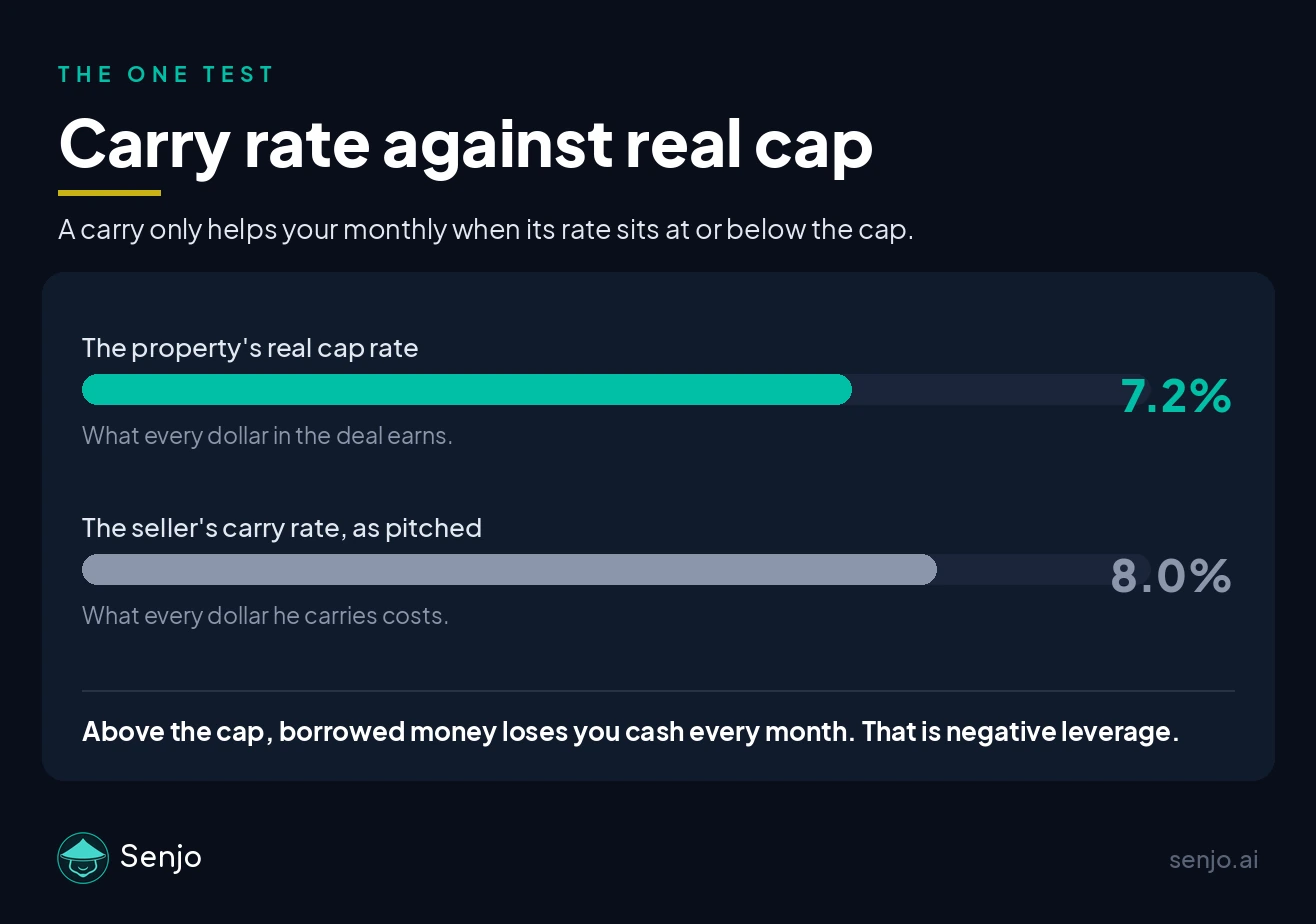
The one test that decides it. Line up two numbers. The first is the cap rate, which is what the building earns on every dollar put into it. The second is the interest rate the seller wants on the money he lends you. When the seller's rate is the lower of the two, the borrowed money earns more than it costs and it helps you.
When his rate is higher, every dollar he carries costs you more than it makes, and the difference comes out of your pocket every month. The industry calls that negative leverage. In plain terms, the loan is working against you instead of for you. And a second loan stacks that on top of whatever your first mortgage is already doing.
What is a seller carry actually doing to your deal?
It is a loan from the seller, and most often a second one. That is the honest one-line definition, and it is the one the pitch skips. Instead of the bank funding the whole price, the seller agrees to lend you part of it and take payments over time, sitting behind the bank in line to be paid.
It does not always take that shape. Sometimes a seller owns the building free and clear and carries the entire price himself, and then there is no bank and only one payment to make. That version is simpler to underwrite and rarer to find. The common one, and the one this post takes apart, is a seller filling the gap behind a bank loan. Know which of the two you are being offered before you do any math, because they are not the same deal.
The appeal is real. A bank on a small commercial multifamily lends well short of what a residential buyer is used to, often somewhere in the sixty-five to seventy-five percent range, and the exact ceiling moves with the lender, the asset, and the borrower. A beginner short on cash gets stuck at the down payment. A seller who carries the gap lets you in for five or ten percent instead of thirty. That is the door a handful of creative-financing teachers built real portfolios through, and the concept is sound. The arithmetic is where people stop looking.
Here is the part the concept videos rarely show. That carry is now a monthly obligation sitting on top of your first mortgage, often at a higher rate and a shorter payback than the bank loan, because the seller wants his money back inside ten or fifteen years, not thirty. Two payments, not one.
The question was never whether you can get the seller to carry. It was whether this specific deal still pencils once the carry stacks on the first position. That is a different question from which loan to use, and it only shows up when you price both payments together.
What did the deal look like on the surface?
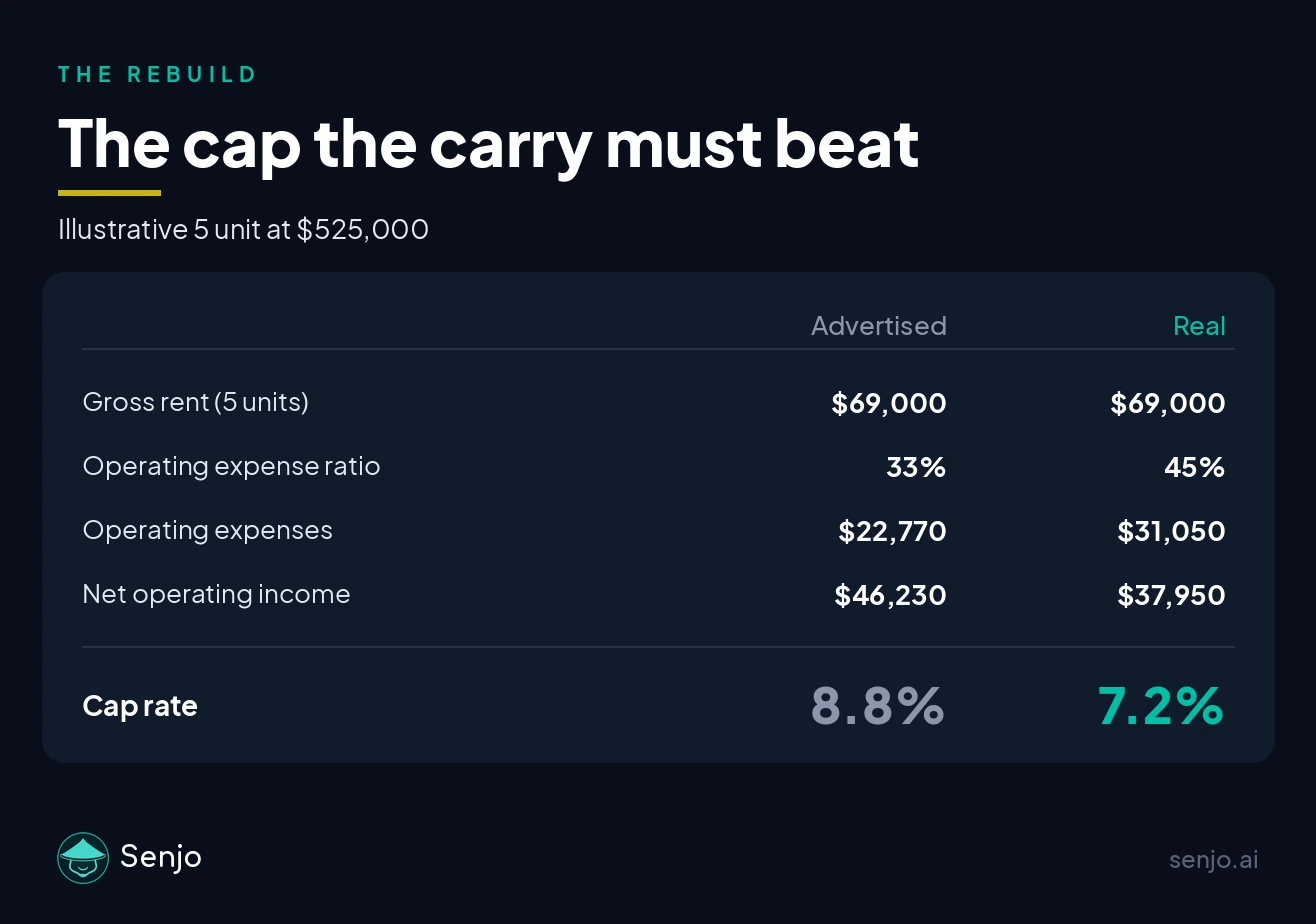
Like every first-time buyer's dream, which is exactly the point. A 5 unit at 525,000 dollars, advertised at an 8.8 cap, with a seller willing to carry thirty percent so you could get in for about twenty-six thousand dollars down. Five units at 1,150 dollars a month, so 69,000 dollars of gross scheduled rent. A motivated seller and a way past the bank's wall in the same listing. All figures here are illustrative.
That is the surface. It is also the number a broker builds to make the phone ring. An advertised cap is almost always built on the seller's expenses, not yours, and the gap between the two is where the real read starts. These are the same lines a listing tends to leave out, and every one of them compounds the moment a second loan enters the picture.
Why was an 8.8 cap really a 7.2?
Because the advertised number was built on a 33 percent expense ratio. The real one, once you price in the expenses a seller tends to leave off, taxes reassessed at your purchase price, real management, real vacancy, real repairs, ran closer to 45 percent. That drops net operating income from the advertised 46,230 dollars to about 37,950, and the cap from 8.8 to 7.2.
Why the gap matters more here than usual. On an all-cash or conventionally financed deal, a 7.2 cap is simply a lower return than advertised. On a seller-carry deal, it is the line the carry has to beat. If the seller wants eight percent on his note and the property yields 7.2, every dollar he carries costs more than it earns. The advertised 8.8 hid that the carry rate was already underwater against the true yield.
If you have not run that check on your own listing, start with the 60 second cap rate rebuild, then come back to the carry.
What did the stacked carry do to the monthly?
It cost about 860 dollars a month, and the carry is the entire reason. Split the debt in two and it is obvious.
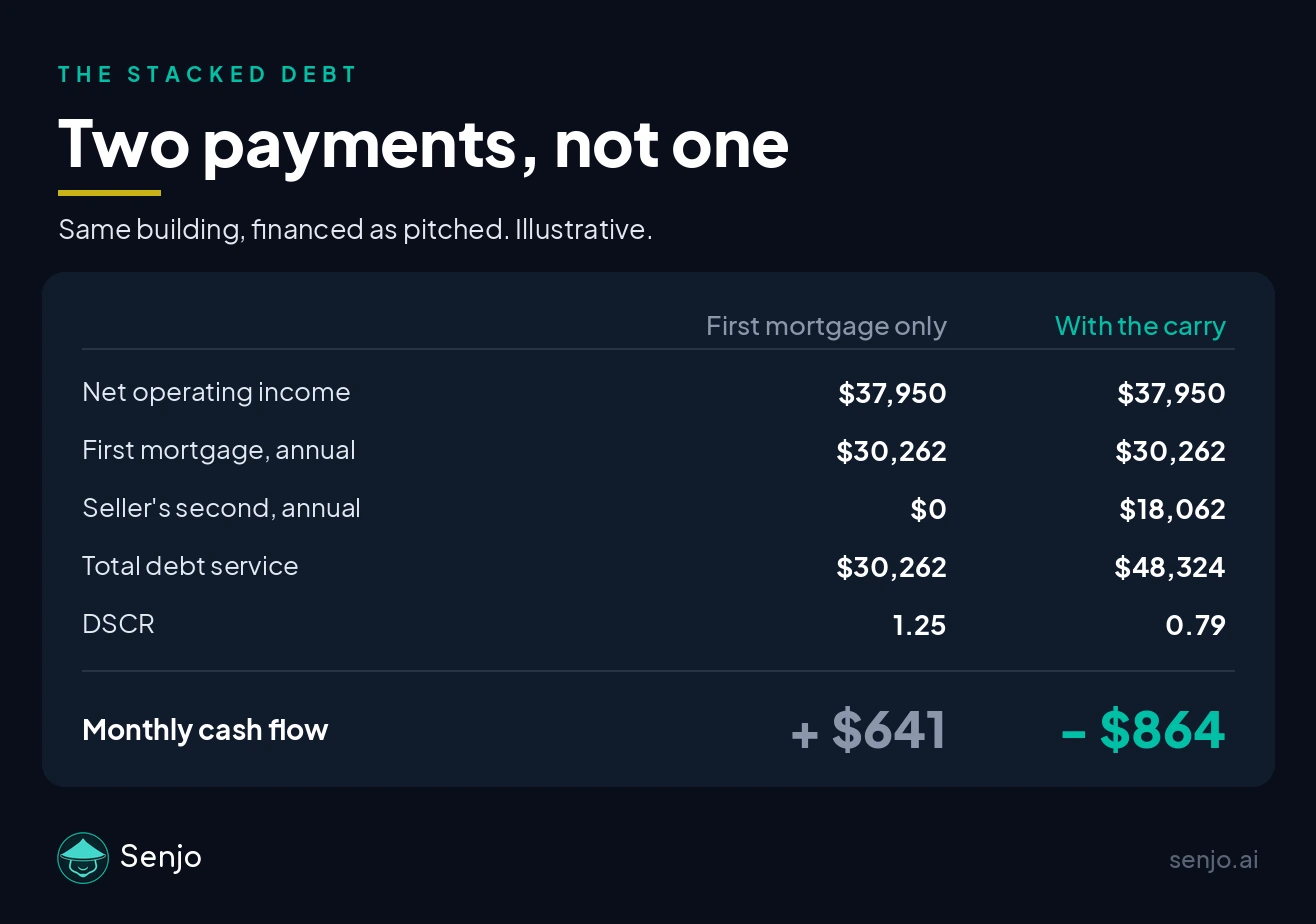
The first mortgage alone. Sixty-five percent of the price, about 341,000 dollars, at 7.5 percent over 25 years, runs roughly 2,520 dollars a month, or 30,262 a year. Against 37,950 dollars of net operating income, that is a DSCR of 1.25 and a little under 7,700 dollars of yearly cash flow. On the bank loan alone, this deal breathes.
Add the seller's second. Thirty percent, about 157,500 dollars, at eight percent amortized over fifteen years, adds roughly 1,505 dollars a month. Total debt service jumps to about 48,324 a year. Combined DSCR falls to 0.79, and the monthly goes from positive to about negative 860 dollars.
Nothing about the building changed between those two paragraphs. The rents, the expenses, the net operating income are identical. The nothing-down structure is what turned a thin but positive deal into one that bleeds ten thousand dollars a year. That is the number the pitch never puts on screen, and nobody is going to put it there for you.
Which terms made it pencil?
Three of them, and none touched the purchase price. The deal was not dead. It was mispriced on terms, and terms are the one thing a seller carry lets you negotiate.
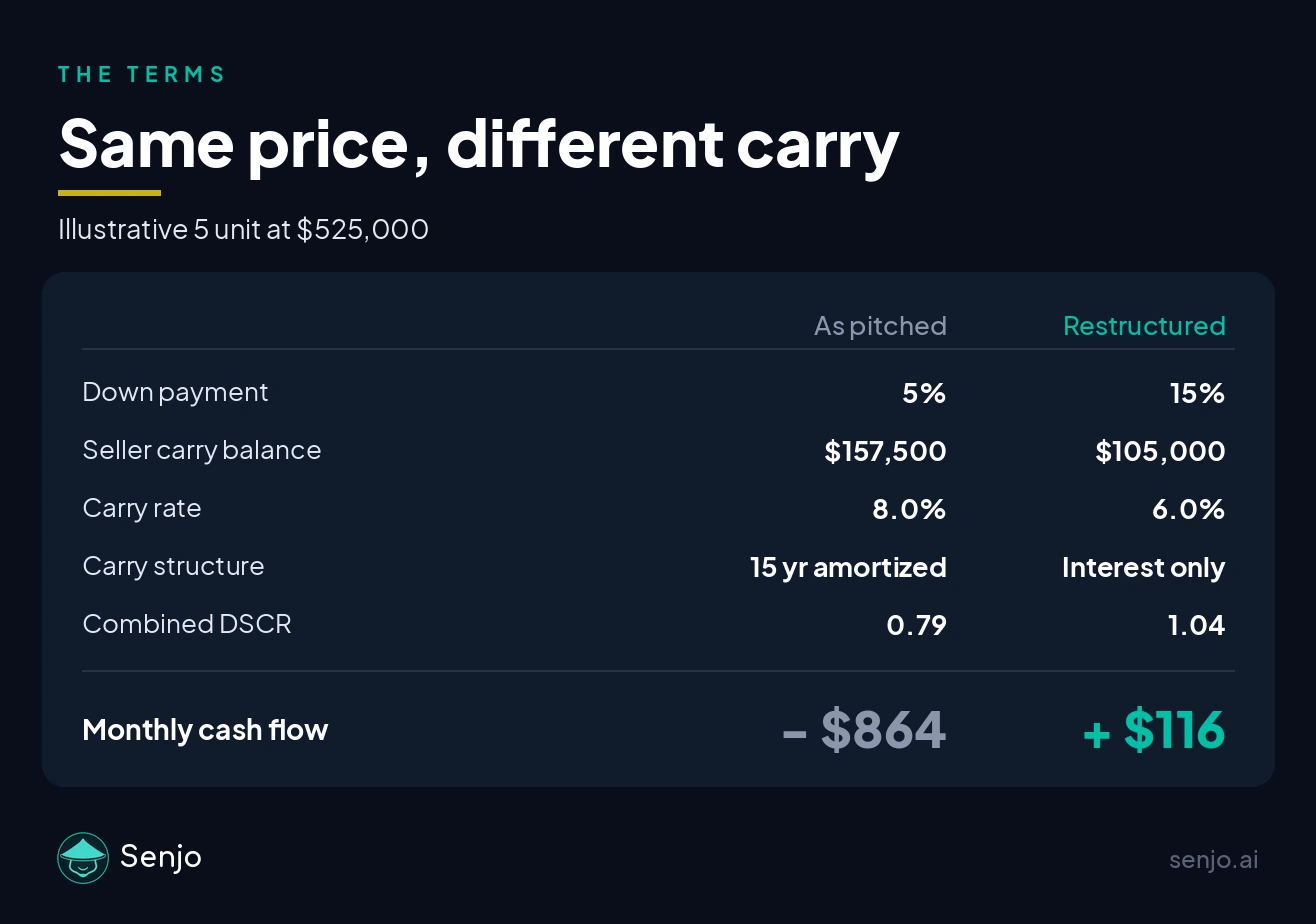
Cut the carry balance. Bringing fifteen percent down instead of five shrinks the seller's second from 157,500 dollars to 105,000. Less money borrowed at the highest rate on the deal.
Make it interest only. A fifteen-year amortization on the carry front-loads principal you do not need to pay yet. Interest only for the first five years drops the payment to what the money actually costs.
Get the rate at or below the cap. At six percent interest only, the carry runs about 525 dollars a month instead of 1,505. Six is at the property's real cap, so the borrowed dollars stop losing money.
Together, total debt service falls to about 36,562 dollars a year, combined DSCR climbs back to 1.04, and the monthly turns to roughly positive 115 dollars. Thin, but positive, with the first mortgage paying itself down underneath. Same building, same price, a carry structured to help the deal instead of sink it.
So what does this mean for your offer?
As pitched it was a pass. Restructured it was a deal. The seller financing did not rescue a weak building. It put a set of terms on the table, and both positions had to be priced before deciding which terms to accept.
That is the reframe worth keeping. Seller financing is not a cash-flow machine and it is not free money. It is flexibility, and flexibility is only worth something if you underwrite the stacked debt instead of celebrating the low down payment.
So the offer is not yes, carry it. The offer is carry this much, at this rate, on these terms, because that sentence is the difference between minus 860 and plus 115 dollars a month on the identical deal.
Before you send a single seller-carry offer, price the second position the way you price the first. If you cannot see both payments against the real net operating income at the same time, you are not analyzing the deal. You are hoping.
The read, at a glance, illustrative
| Asking price | $525,000, 5 units |
| Advertised cap | 8.8% |
| Real cap | 7.2% |
| Real net operating income | $37,950 |
| DSCR, first mortgage alone | 1.25 |
| Combined DSCR, as pitched | 0.79 |
| Monthly cash flow, as pitched | about - $860 |
| The terms that flip it | 15% down, $105,000 carry at 6% IO |
| Combined DSCR, restructured | 1.04 |
| Monthly cash flow, restructured | about + $115 |
Illustrative 5 unit, five units at 1,150 dollars a month, so 69,000 dollars of gross scheduled rent against a 45 percent expense ratio. A first mortgage at 65 percent of price on a 7.5 percent, 25 year amortization, with the seller carry sitting behind it. Not a real listing and not a deal I bought. Rates, carry terms, and what a seller will actually agree to vary widely. Price your own.
Frequently asked
Does seller financing mean no money down?
Not usually. A seller carry can lower your down payment by covering the gap the bank will not fund, but it usually does that by adding a second loan with its own payment. Less cash in is real. Zero cost is not.
Is a seller carry cheaper than a bank loan?
Often it is more expensive, not less. Sellers frequently want a higher rate and a faster payback than a bank, because they are trading a lump sum for payments and want their capital back sooner. Always compare the carry rate to the property's real cap rate before assuming it helps.
How does a second-position loan affect DSCR?
It lowers it. DSCR measures net operating income against total debt service, so every payment you add, including a seller carry, raises the denominator. A deal that clears 1.25 on the first mortgage alone can fall below 1.0 once the carry stacks on top.
What terms should I ask a seller to carry?
The three that move the monthly most: a smaller carry balance, an interest-only period, and a rate at or below the property's real cap rate. Those are what turned the illustrative deal above from negative to positive without changing the price.
Can Senjo get me seller financing?
No. Senjo does not broker, source, or structure loans. It underwrites the deal against the real numbers rather than the listing's, and it runs the same deal across the financing structures it supports so you can see which one clears and what you would anchor on. Finding a seller willing to carry is still your work.
Senjo is an AI sensei for solo multifamily investors. Fernando, its founder, owns two single family rentals and is working toward his first small multifamily deal, building the tool he needed when he got stuck between the two.