The Explainer
What should I look for when I walk a multifamily building?
The First Deal Series, Part 3 of 4
Fernando, founder of Senjo · 7 min read
TL;DR
A walk-through is not a pass or fail test. It produces one number: the cash it will take to get the building into the shape your plan assumes. That number does not move the building's yearly profit, so it does not move the cap rate or the lender's coverage test either. What it moves is your cash. On the illustrative 6 unit below, asking 480,000 dollars, the walk took the repair budget from 45,000 dollars to 78,000. The deal still cleared both of its floors, lender coverage of 1.25 and 500 dollars a month in cash flow. The return on the cash invested fell from 4.8 percent to 3.9 percent, and the loan coverage never moved at all. The question is never whether the building is broken. It is whether it still works at the new number, and whether you still have the cash. Every figure here is illustrative. It is not a real listing and not a deal I bought.
What should you actually look for when you walk a multifamily building?
You are not looking for a reason to walk away. You are looking for one number: what it will cost to get this building to the condition your plan already assumes.
Most first-timers walk a building the way they walk a house they might live in. They react to what they see. Stained ceiling, bad feeling, move on. An operator walks the same building with a notepad and a running total, giving every item a rough cost and a rough date, treating nothing as a verdict on its own.
Reacting is expensive in both directions. It kills fixable deals, and it lets cheap-looking disasters through.
If you own a single family rental you have done a version of this, but the stakes scale. On a house a surprise repair is an annoying weekend. On a six unit the same surprise arrives six times, and it lands on a loan that is watching your numbers.
The useful way to hold it: the listing gave you the building's income, the walk gives you its condition. Until you have walked it, you are underwriting half a deal.
Does what you find on the walk change the cap rate?
No. This surprises almost everyone, and understanding why is most of the value of the walk.
Start with the words, because they get used loosely. Net operating income, or NOI, is what the building earns in a year after operating expenses and before the mortgage. Cap rate is that yearly profit divided by the price, so a building earning 35,000 dollars priced at 480,000 is roughly a 7.4 cap. It compares two buildings on one scale, nothing more.
Debt service coverage ratio, or DSCR, is that same yearly profit divided by your yearly loan payments. It is the lender's test that the building pays its own mortgage, and most multifamily lenders want at least 1.25. Cash-on-cash return is the yearly cash you keep, divided by all the cash you put in: down payment, closing costs, and repairs.
Here is the key. A roof, a parking lot, a set of water heaters are one-time costs, not yearly operating expenses. They never enter the yearly profit, so they do not touch the cap rate and they do not touch the lender's coverage test.
What they touch is your cash, and the return you earn on it. Two buildings with an identical 7.4 cap can hand you very different cash-on-cash returns, and the difference is often sitting in the parking lot. So the walk cannot be skipped, and panicking about what it finds is still a mistake. The lender's test does not care. Your bank account does.
One thing to separate out. The yearly amount you set aside for future big-ticket repairs is a real operating expense and does belong in your yearly profit. That is a different number from the one-time budget this article is about. If you have not corrected the yearly side yet, do that first, because what most people miss when they underwrite a small multifamily sits upstream of everything here.
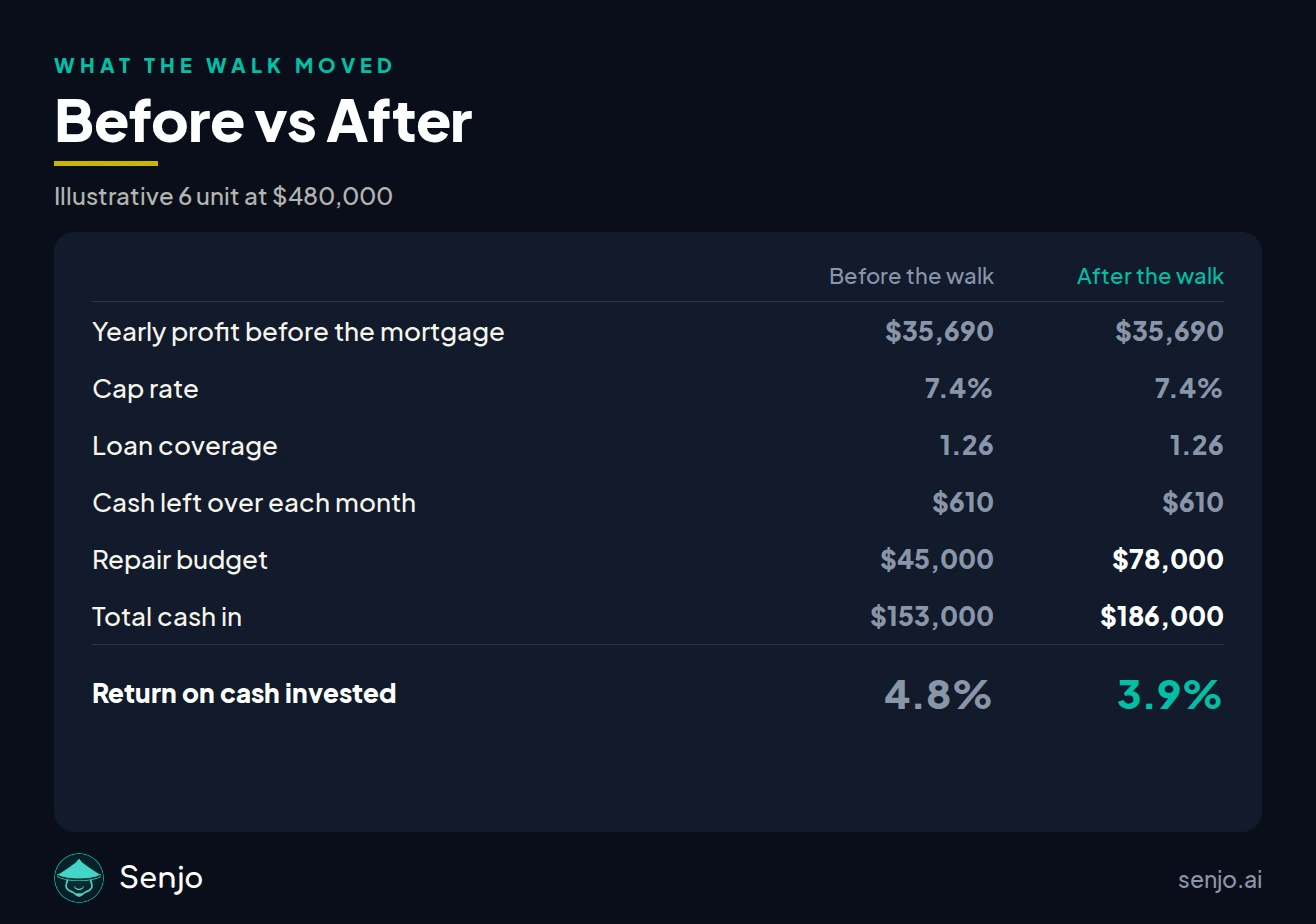
What did the walk do to one illustrative 6-unit?
It moved the repair budget from 45,000 dollars to 78,000, cut the return on invested cash from 4.8 percent to 3.9 percent, and left the cap rate and the coverage test untouched.
The building. A 6 unit listed at 480,000 dollars, a different illustrative building from the one in Parts 1 and 2. Six units at 975 dollars a month, so 70,200 dollars of rent a year if every unit stays full. After 5 percent for vacancy and 31,000 dollars of corrected operating expenses, it earns 35,690 dollars a year before the mortgage, which is a 7.4 cap at the asking price. Every figure here is illustrative.
Two floors were set beforehand: lender coverage of 1.25 and 500 dollars a month in cash flow. The deal clears both, and it clears the lender's by almost nothing, 1.26 against 1.25. Which loan you use sets that coverage floor, and the two common paths do not set it in the same place, which is worth reading before you assume the 1.25.
Repairs planned from the listing photos: 45,000 dollars. Four unit refreshes and a roof allowance. Cash to close was 96,000 dollars down plus about 12,000 in closing costs, so total cash in was 153,000 dollars and the return on that cash was 4.8 percent.
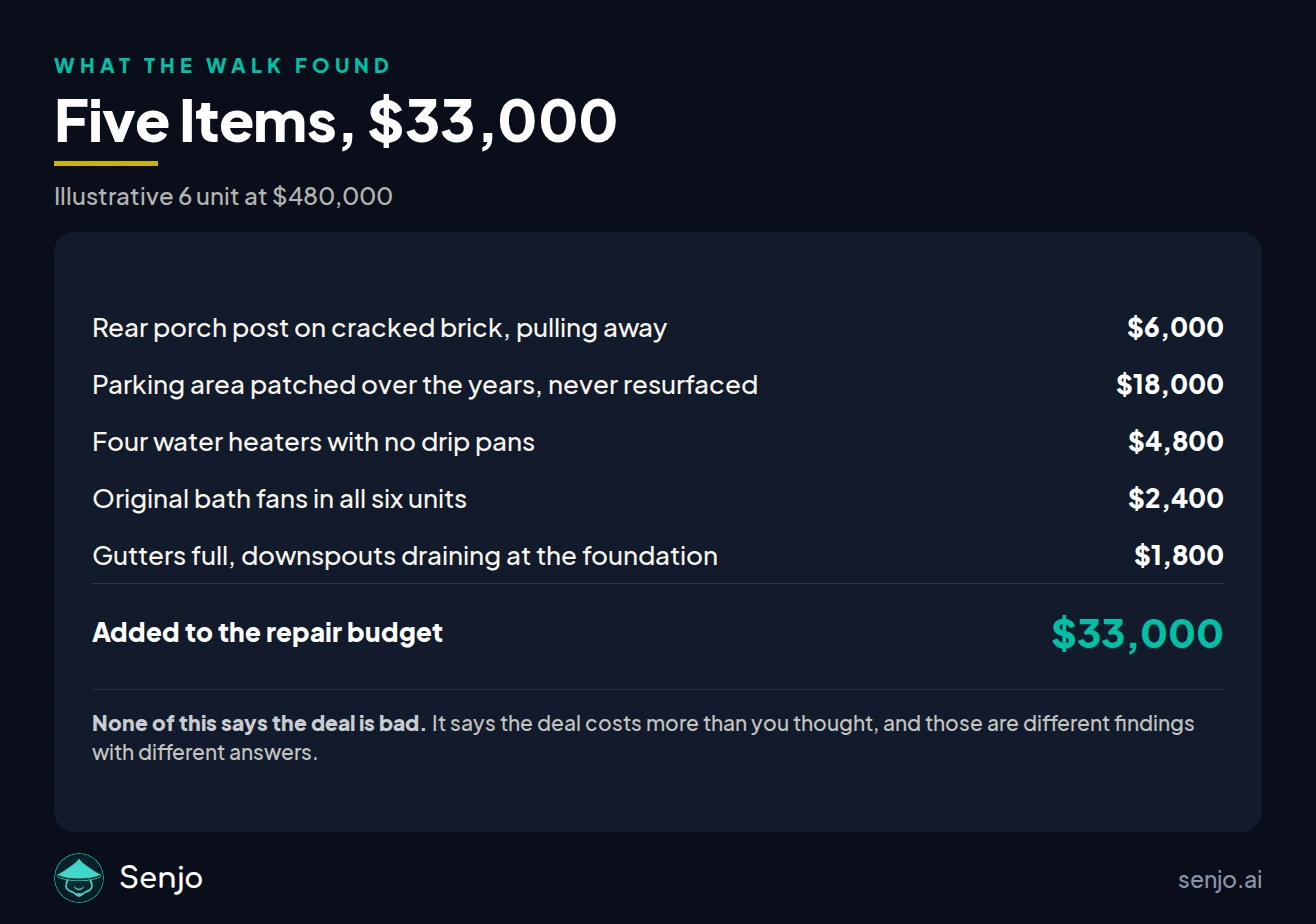
Then the walk found another 33,000 dollars across five items. A rear porch support post sitting on cracked brick and pulling away from the building. A parking area patched over the years and never resurfaced. Four water heaters with no drip pans, sitting above finished floor. Original bath fans in all six units, loud enough that tenants will not run them. Gutters full, with downspouts draining against the foundation.
Nothing above the repair line moved. The yearly profit, the cap rate, the loan coverage, and the cash left over each month are all exactly where they were, and the deal still clears the 1.25 coverage floor and the 500 dollar a month floor. What broke is the cash. You are 33,000 dollars short of the plan you walked in with.
That is the whole lesson. The walk did not tell you the deal was bad. It told you the deal costs more than you thought. Those are different findings, and they have different answers.
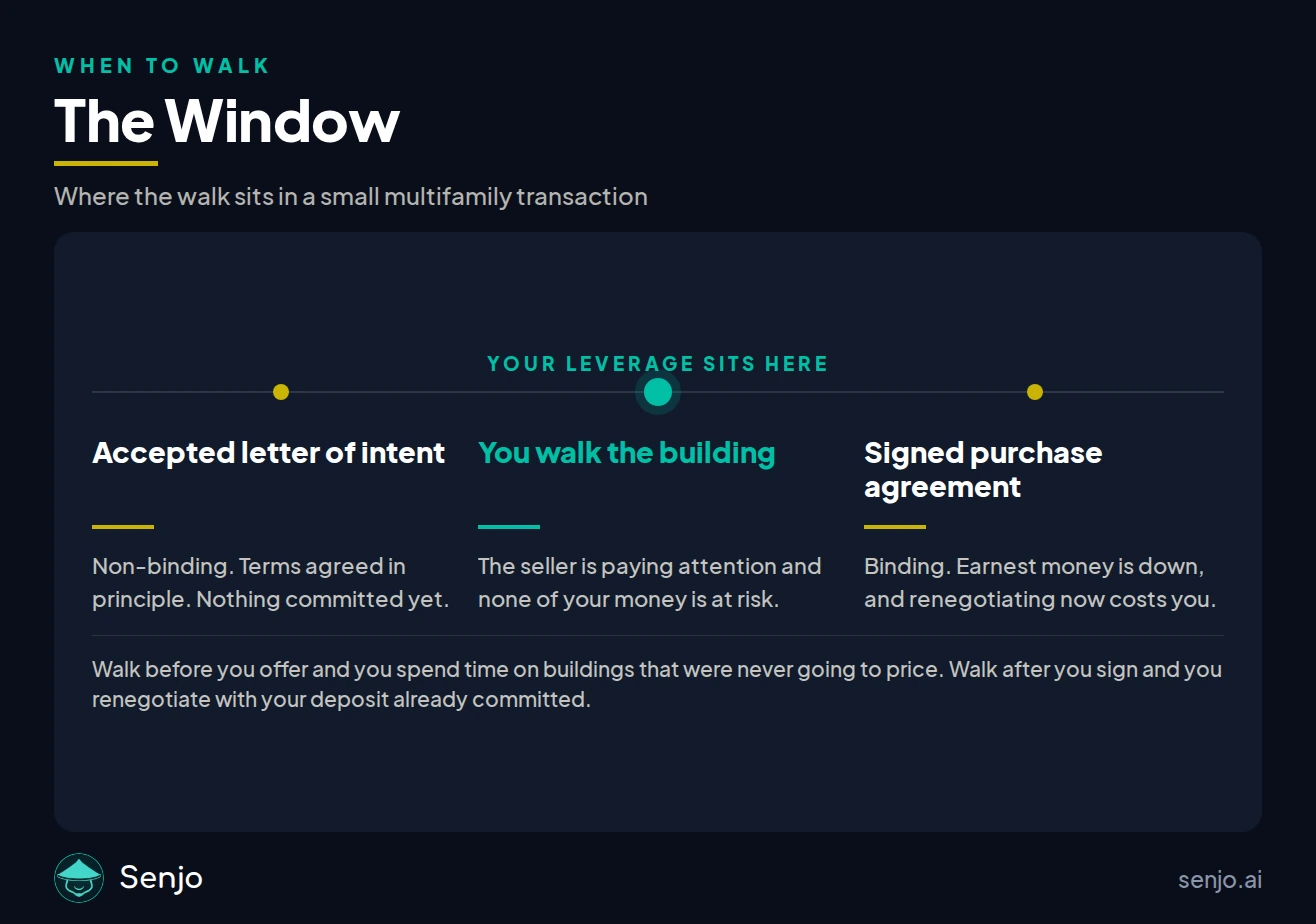
Should you walk before or after you make the offer?
After. Walk once you have an accepted letter of intent and before you sign the purchase agreement.
Two terms, new to most people coming from single family. A letter of intent is a short, non-binding document saying you intend to buy at roughly these terms. The purchase agreement is the binding contract that follows, and signing it usually means putting down earnest money that is at risk if you back out for the wrong reasons.
Walking before you offer wastes time on buildings that were never going to price. Walking after you sign means renegotiating from a worse position with money already committed. The window between the two is where your leverage sits: you have the seller's attention and you have not committed anything yet.
This assumes you decided your price and your walk-away number before you submitted. If you set your top price at the table, after you have already fallen for the building, the walk will not save you.
Then re-run it. You came back with a corrected repair number, so put it into the model and see what it does to both floors. Not just the return. The cash too.
Senjo already holds your capital position, your cash flow floor, and your credit tier, so the corrected number goes in and the read comes back against your plan rather than a generic benchmark, along with the price the deal would have to move to in order to clear. It does not inspect buildings, estimate repair costs, or quote contractors. You supply the number the walk gave you.
Next in the series. Part 4 covers sorting what you found and the three ways to get the money back: which problems should actually stop a deal, and what to do with the number once you have it.
The desk read, before the walk, illustrative
| Asking price | $480,000, 6 units |
| Rent if fully occupied all year | $70,200 |
| Less vacancy and missed rent, 5% | ($3,510) |
| Rent you actually collect | $66,690 |
| Yearly operating expenses, corrected | $31,000 |
| Yearly profit before the mortgage | $35,690 |
| Cap rate at the asking price | 7.4% |
| Loan, 80% of price, 6.25%, 30 years | $384,000 |
| Yearly loan payments | $28,370 |
| Loan coverage | 1.26 |
| Cash left over each month | $610 |
Illustrative 6 unit, not a real listing and not a deal I bought. A different building from the one in Parts 1 and 2, which asks $520,000. Floors set in advance: 1.25 coverage and $500 a month, and the deal clears the lender's by 0.01. Repairs planned at $45,000 put total cash in at $153,000 and the return at 4.8 percent. The walk's $33,000 takes those to $186,000 and 3.9 percent and moves nothing else in this table. Rates, lender floors, and repair costs vary. Price your own.
Frequently asked
Does a walk-through change the cap rate?
No. Cap rate is the building's yearly profit divided by its price, and that profit is built from yearly income and yearly expenses. A one-time cost like a roof or a parking lot is not a yearly operating expense, so it never enters the calculation. It changes your total cash invested, and therefore your return on that cash. It does not change the cap rate or the lender's coverage test.
How much should I budget for repairs before I walk a multifamily?
Set a placeholder from the listing photos and the age of the building, then treat it as provisional until you have walked it. On the illustrative 6 unit above, the placeholder was 45,000 dollars and the walk moved it to 78,000. Expect the number to move. If it does not move at all, you probably did not look hard enough.
Should I walk the building before or after I make an offer?
After an accepted letter of intent and before a signed purchase agreement. Before the offer, you are spending time on buildings that may never price. After the purchase agreement, you are renegotiating with your deposit already committed.
Is walking a six unit different from walking a single family rental?
The mechanics are similar and the stakes are not. A surprise repair on a house is one repair. The same surprise on a six unit is often six, and it lands on a loan with a coverage test attached. The habit that carries over is walking with a running total instead of a gut reaction. The habit that does not is trusting your feel for what things cost, because unit counts multiply small numbers fast.
Senjo is an AI sensei for solo multifamily investors. Fernando, its founder, owns two single family rentals and is working toward his first small multifamily deal, building the tool he needed when he got stuck between the two.