The Explainer
Which walk-through problems should actually stop a multifamily deal?
The First Deal Series, Part 4 of 4
Fernando, founder of Senjo · 6 min read
TL;DR
Almost everything you find on a walk is a line item with a price. Very little is a reason to stop. A red flag is a safety or structural problem, or a cost big enough to change the deal by itself, and everything else is a yellow flag you price and carry. The pattern matters more than any single item: when every cheap repair has been skipped, expect worse after closing, so treat it as a pricing input rather than a verdict. Once you have the number you have three ways to recover it, and they are not equal. A price reduction beats a closing credit of the same size, because it shrinks your loan as well as your cash. On the illustrative 6 unit carried over from Part 3, a 33,000 dollar price cut produced a better deal than a 33,000 dollar credit on every measure, including the loan coverage your lender tests. Every figure here is illustrative. It is not a real listing and not a deal I bought.
Which problems should actually stop a deal?
Safety problems, structural problems, and any single cost big enough to break the deal on its own. That is a short list, and almost nothing else belongs on it.
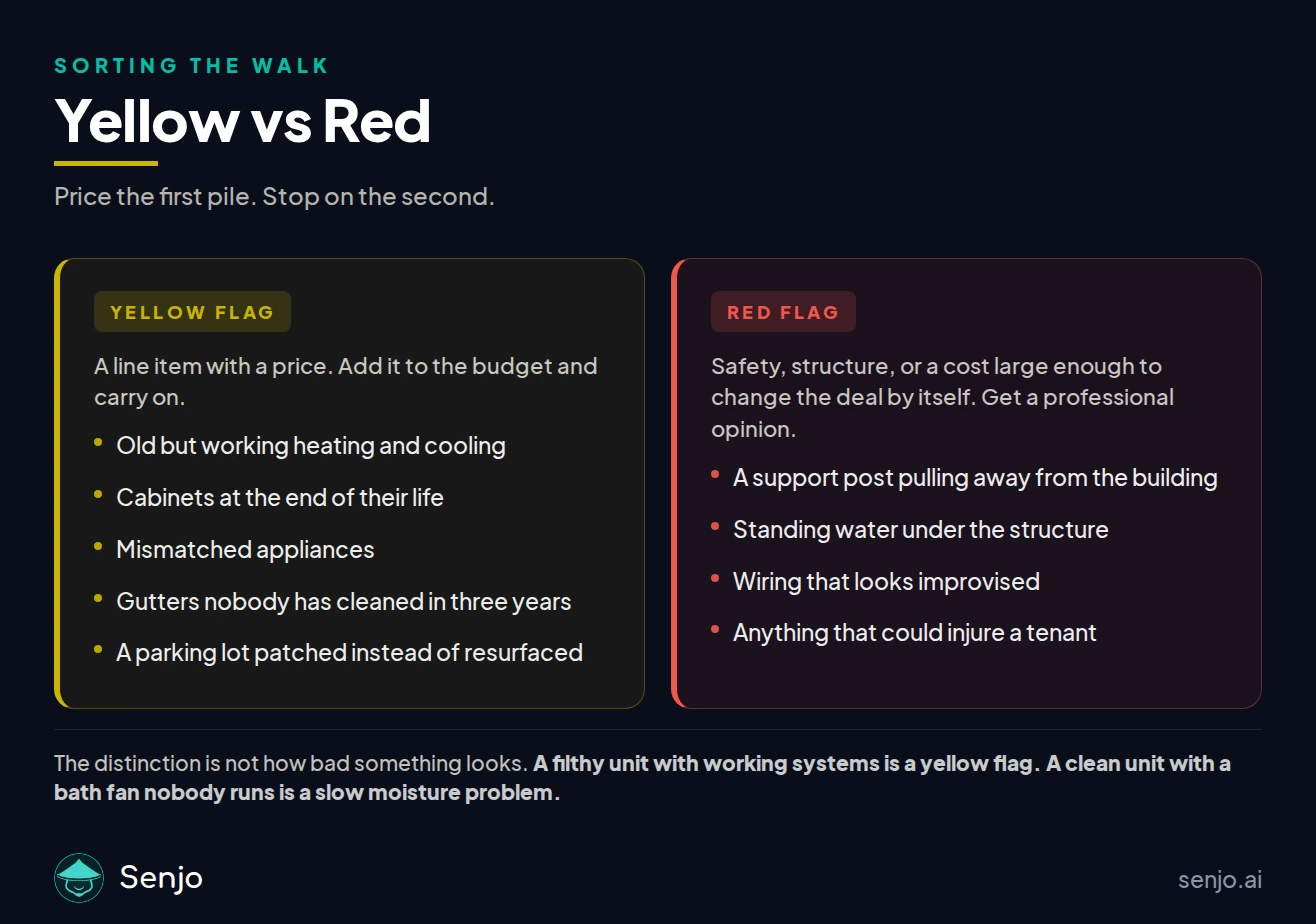
Everything else is a line item with a price. The reason to sort findings into two piles is that the piles behave differently. The small ones accumulate. The big ones decide.
Yellow flags. Price them and move on. Old but working heating and cooling. Cabinets at the end of their life. Mismatched appliances. Gutters nobody has cleaned in three years. A parking lot that has been patched instead of resurfaced. None of these stop a deal. All of them cost money, and the money is the point.
Red flags. Stop and get a professional opinion. A support post pulling away from the building. Standing water under the structure. Wiring that looks improvised. Anything that could injure a tenant. These are not line items, because you cannot responsibly price them from a walk-through, and because the liability attaches to you the day you close.
The distinction is not about how bad something looks. A filthy unit with working systems is a yellow flag. A clean unit with a bathroom fan nobody runs is a slow moisture problem. Cosmetics photograph badly and cost little. Systems photograph fine and cost a lot.
If you are coming from single family, this is the habit worth unlearning: on a house you can afford to react to condition, because there is one of everything. On a six unit there are six of everything, and reacting to condition instead of pricing it is how people talk themselves out of deals that worked.
What does a building full of small unfixed problems tell you?
That the owner deferred everything cheap, and that what you find after closing will probably be worse than what you found on the walk.
This is the most useful pattern I have picked up from watching operators do this, and it is worth more than any single checklist item. The gutters, the expired fire extinguisher tag, the downspout draining against the foundation, the loose handrail. Individually these are rounding errors. Collectively they are a management history.
The logic is simple. Cheap, visible maintenance is the easiest thing in the world to do. If it was skipped, it was skipped on purpose, usually because money was tight or attention was elsewhere. The expensive, invisible maintenance was skipped too. You just cannot see it yet.
So raise the budget and widen the contingency. A pattern of neglect is a pricing input, not a verdict.
On the illustrative 6 unit in Part 3, five unattended items took the repair budget from 45,000 dollars to 78,000. That moved the deal from comfortable to tight. It did not move it from good to bad, and at the corrected number it was still worth buying. Most buildings with a long list of small problems land there. The ones that do not are the ones with a red flag on the list.
What do you do with the number once you have it?
You have three moves, and they are not equally good.
A quick recap of the illustrative deal from Part 3, since the moves only make sense against numbers. A 6 unit listed at 480,000 dollars, earning 35,690 dollars a year before the mortgage, financed at 80 percent of price, 6.25 percent, 30 years. Repairs were planned at 45,000 dollars. The walk found another 33,000, taking the budget to 78,000 and the return on cash from 4.8 percent down to 3.9. All figures illustrative.
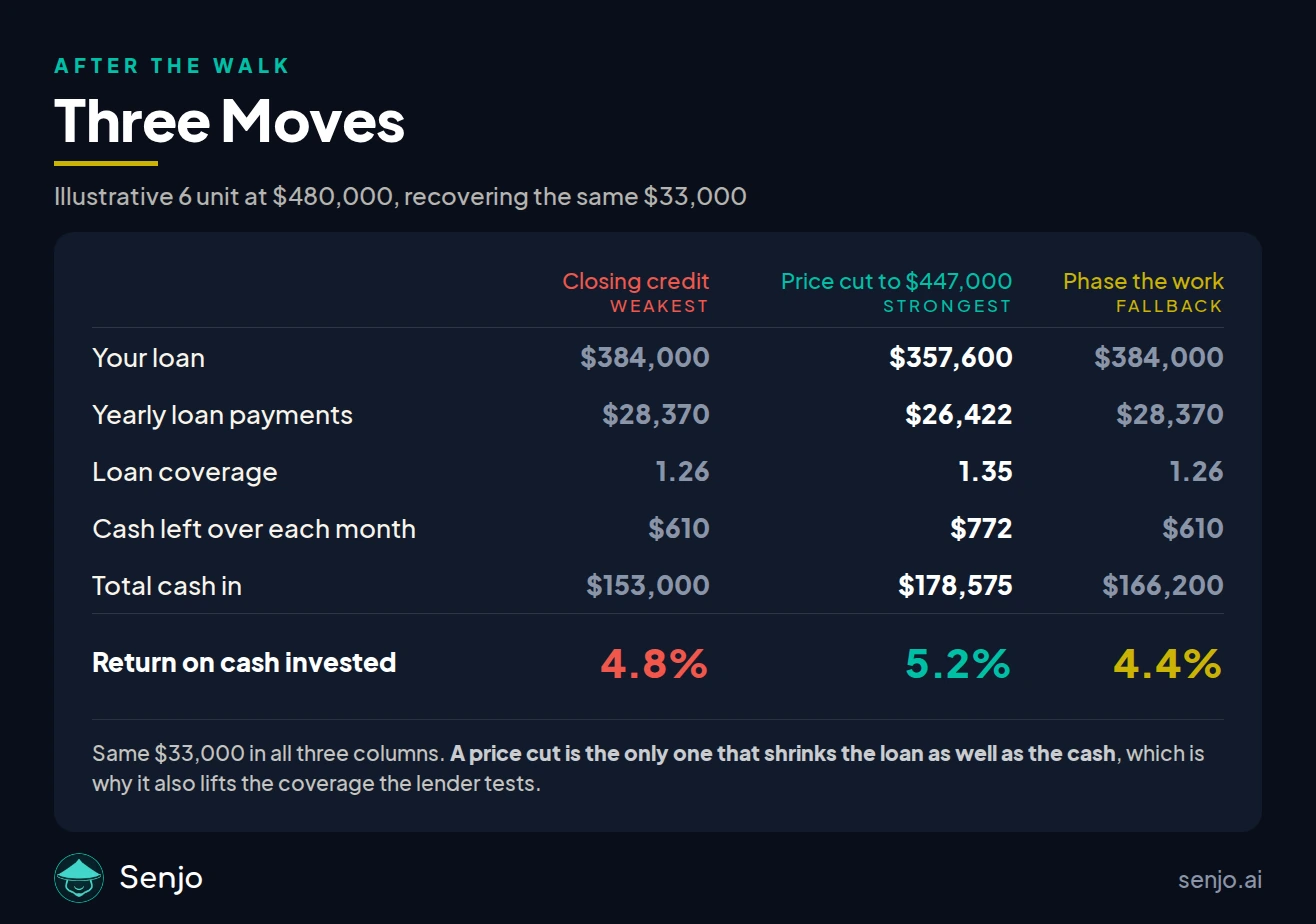
1. Ask for a closing credit. Take the 33,000 dollars to the seller as a credit at closing. It is the fastest move and the weakest one, because it fixes your cash position and does nothing to your loan. You still borrow the same amount and you still make the same payment for thirty years.
2. Move the price. Reprice the building down by the same 33,000 dollars, to 447,000. This does more work, because a lower price shrinks the loan as well as your down payment. Yearly loan payments drop to about 26,400 dollars. Cash left over each month rises to about 772. Loan coverage improves from 1.26 to 1.35, which matters because you were clearing the lender's 1.25 floor by almost nothing. The return on your invested cash lands near 5.2 percent, better than the 4.8 percent you started with before the walk found anything.
Same 33,000 dollars, meaningfully better deal. This is the move most first-timers do not ask for, because a credit feels more polite. Property taxes would also reset slightly lower at a lower price, which these figures ignore.
3. Phase the work. Only three items are year-one work: the porch, the water heaters, and the bath fans, about 13,200 dollars of the 33,000. The parking lot can wait two years and get paid for out of cash flow. Year-one repairs become 58,200 dollars and the return on cash holds near 4.4 percent. This is the honest move when the seller will not budge and you still want the building.
What you should not do is force it. If the new number puts the deal under your floors, the deal is under your floors.
What if the walk pushes the deal below your floors?
Then the number told you something useful and you should listen to it. Rework the price, phase the work, or pass.
The trap here is not financial, it is psychological. By the time you walk a building you have spent weeks on it. You have run the numbers, negotiated a letter of intent, maybe told someone about it. That investment is gone either way, and it is the single most common reason people talk themselves past their own floors.
The floors exist precisely for this moment. You set them when you were calm and had no particular building in mind. Deciding they were negotiable while standing in a parking lot you now feel attached to is not a revised analysis. It is an attachment wearing the costume of one.
Re-running it honestly is the whole discipline. Put the corrected repair number back in, check both floors again, and let the answer be the answer.
Senjo holds the floors you set, your capital position, and your credit tier, so a corrected number produces a read against your own plan rather than a general benchmark, plus the price the deal would need to reach in order to clear. It does not inspect buildings or estimate repair costs. You bring the number the walk gave you.
The same $33,000, three ways, illustrative
| Repair budget after the walk | $78,000 |
| Do nothing, return on cash | 3.9% |
| Closing credit, return on cash | 4.8% |
| Price cut to $447,000, loan coverage | 1.35 |
| Price cut to $447,000, cash left each month | $772 |
| Price cut to $447,000, return on cash | 5.2% |
| Phase the work, year one repairs | $58,200 |
| Phase the work, return on cash | 4.4% |
Illustrative 6 unit asking $480,000, carried over from Part 3, earning $35,690 a year before the mortgage. Financing at 80% of price, 6.25%, 30 years. Floors of 1.25 coverage and $500 a month. A credit leaves the loan at $384,000 and coverage at 1.26, so it only returns you to the pre-walk position. The price cut is the only move that lowers the loan, which is why it is the only one that lifts coverage. Property tax would also reset slightly lower at a lower price, which these figures ignore. Price your own.
Frequently asked
What is the difference between a yellow flag and a red flag on a walk-through?
A red flag is a safety issue, a structural issue, or a cost large enough to change the deal by itself. A yellow flag is anything that is simply a line item with a price. Yellow flags get priced and added to the budget. Red flags stop the walk and get a professional opinion before you go further.
Can I ask the seller to pay for what the walk finds?
Yes, and a price reduction is usually better than a closing credit of the same size, because a lower price shrinks your loan as well as your cash outlay. On the illustrative deal above, a 33,000 dollar price move beat a 33,000 dollar credit on cash flow, on loan coverage, and on return.
Does finding a lot of small problems mean I should walk away?
Not by itself. It means you should raise your repair budget and widen your contingency, because unfixed cheap maintenance usually signals unfixed expensive maintenance you cannot see yet. Treat it as a pricing input. Then check whether the deal still clears your floors at the higher number.
Should I phase repairs or do them all at once?
Phase anything that is not safety-related and not required by your lender or insurer. Safety items and anything causing ongoing damage, like water intrusion, get done immediately. Cosmetic and deferred items can be funded from cash flow over the first two or three years, which protects the cash you need at closing.
What if the seller refuses to move on price or credit?
Then you are choosing between phasing the work, paying the difference yourself, and passing. All three are legitimate. What is not legitimate is quietly lowering your own floors so the deal still looks like it works. Part 3 of this series covers how those floors get set and what the walk does to them.
Senjo is an AI sensei for solo multifamily investors. Fernando, its founder, owns two single family rentals and is working toward his first small multifamily deal, building the tool he needed when he got stuck between the two.