The Explainer
How do I decide what to offer on my first multifamily?
The First Deal Series, Part 1 of 4
Fernando, founder of Senjo · 7 min read
TL;DR
An offer is not a feeling. It is a set of decisions you make before you submit, and the price is only the first one. You price off two things, what the building earns in a year and what similar buildings recently sold for, and the asking price is not one of them. Then you decide your ceiling, the highest price at which the deal still works, and you decide it before you submit rather than in the room. On the illustrative 6 unit below, asking 520,000 dollars, both methods landed near 460,000 to 468,000 and the ceiling came in at 483,000. The seller was asking 37,000 dollars more than the deal could carry, and that gap is the whole negotiation. Two floors set the ceiling, the lender's coverage test and your own cash flow requirement, and they do not fail at the same price. At 495,000 dollars the building still pays 536 dollars a month and clears the personal floor while the lender's test has already failed. Affordable and fundable are not the same question. Every number here is illustrative. It is not a real listing and not a deal I bought.
How do you decide what to offer on a multifamily?
From two numbers: what the building earns in a year, and what similar buildings nearby recently sold for. The asking price is not an input to either one.
If you own a single family rental, this is the biggest adjustment. You bought that house off comparable sales, because a house is worth what someone will pay to live in it. A multifamily building is priced off what it earns. Not what it looks like, not what the seller wants. It is closer to buying a small business than buying a house.
Run both methods and see where they land.
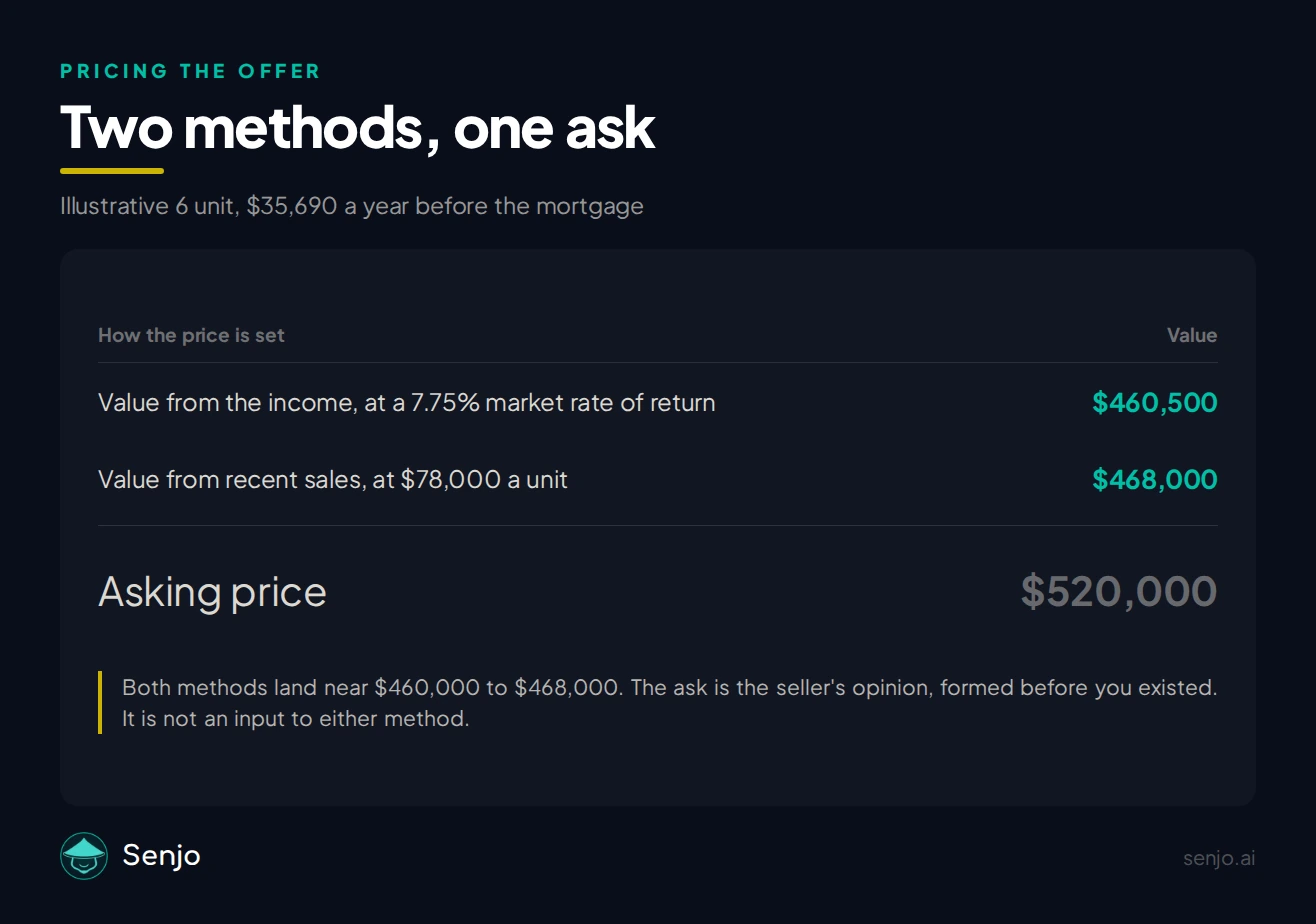
Value from the income. Take the building's yearly profit after operating expenses and before the mortgage, which the industry calls net operating income, or NOI. Divide it by the going rate of return for that kind of building in that area, called the market cap rate. If similar buildings trade around a 7.75 percent return and this one nets 35,690 dollars a year, that is 35,690 divided by 0.0775, or roughly 460,500 dollars.
Value from recent sales. Find what comparable buildings actually sold for in the last twelve months, then reduce it to a price per unit so different sizes compare cleanly. If 6 to 8 unit buildings in that submarket have been trading around 78,000 dollars a unit, a six unit is worth roughly 468,000 dollars.
Two habits make this hold up under pressure. Use closed sales from the last twelve months rather than what is listed today, because active listings are asking prices and asking prices are opinions. And when the two methods disagree badly, stop. Something is wrong with your inputs, and finding out what is cheaper before you write a number down than after.
Why is the asking price not a starting point?
Because it is the seller's opinion, formed before you existed, often by someone with an incentive to aim high.
Most first-timers anchor to it without noticing. They see 520,000 dollars, decide 500,000 sounds like a reasonable discount, and offer that. The number came from nowhere. It is the ask minus a feeling.
The ask is useful, just not in the way people think. It tells you what the seller hopes for and roughly how motivated they are. A building priced well above what its income supports, sitting for months, is telling you the seller has not yet accepted what they own.
One more reason to set it aside: your yearly profit figure is probably not the seller's. If you have not corrected the operating expenses, the income side of your pricing is built on their situation rather than yours, and everything downstream inherits that. The six lines that usually move are worth correcting before you price off any of them.
What is a take price, and why decide it before you submit?
Your take price is the highest price at which the deal still works for you. Decide it before you submit, write it down, and do not move it because the conversation got warm.
It is not what you expect to pay. You should expect to pay less. It is where you stop.
Setting it in advance is the whole discipline, and the reason people skip it is not laziness. At the table you will have spent weeks on the building and pictured owning it, and every one of those hours quietly argues for one more small concession. A ceiling you set while calm is the only thing in the room that is not compromised by wanting the deal.
Your ceiling is not a preference. Two floors set it.
The lender's floor. Lenders test whether the building's yearly profit covers its yearly loan payments with a margin. That ratio is the debt service coverage ratio, or DSCR, and most multifamily lenders want at least 1.25, meaning the building earns 25 percent more than the loan costs. Above a certain price this fails and they simply do not fund you.
Your own floor. The cash you need left over each month after the mortgage. Only you can set this, and it belongs on paper before you look at any building.
Whichever breaks first is your ceiling. Not the higher one. The first one.
What does that look like on one illustrative 6-unit?
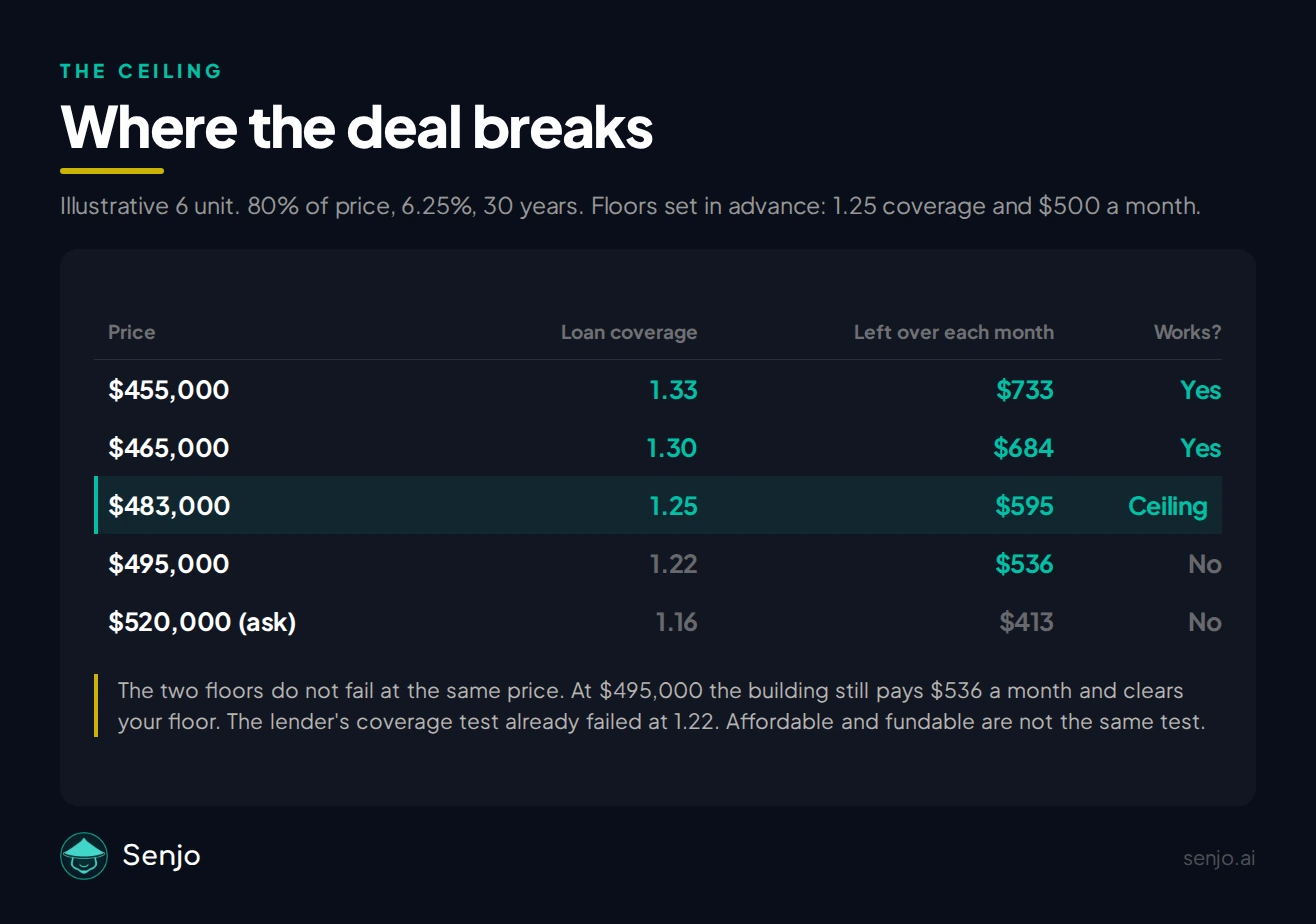
The ceiling came in at 483,000 dollars against a 520,000 ask, so the seller wanted 37,000 dollars more than the building could carry. Every figure here is illustrative.
The building. A 6 unit asking 520,000 dollars, earning 35,690 a year after corrected operating expenses and before the mortgage. Financing at 80 percent of price, 6.25 percent, 30 years. Two floors set in advance: lender coverage of 1.25 and 500 dollars a month left over.
Look at the 495,000 dollar row. There is still 536 dollars a month left over, clearing the personal floor of 500. It feels affordable. But the lender's coverage test already failed at 1.22, and no amount of wanting the building changes that. The two floors do not fail at the same price, and the one that fails first is usually the one you cannot argue with. That is why a ceiling is a calculation and not a comfort level.
So the range going in: open at 455,000 dollars, below both methods with room to move. Expect to land near 465,000, inside what the sales support. Walk above 483,000, not reluctantly, mechanically.
One honest note the panel ignores: property taxes usually reset to what you pay, so a lower price slightly improves the yearly profit and nudges the ceiling up. It moves things by less than the negotiation will.
This three-price shape is what Senjo produces from a deal. It reads the building against the profile it already holds, your capital position, your cash flow floor, your credit tier, and returns the price the deal still works up to, the asking price, and the point above which it stops working, with the reasoning for each. What you get is a defensible range to negotiate inside, instead of a single yes or no with nowhere to move. The paperwork stays with you and your agent.
What happens when they counter?
They will. Plan on it. The counter is where the take price earns its keep.
Say you open at 455,000 dollars and it comes back at 495,000, above your ceiling of 483,000. You have three honest responses, and none of them is "well, it is only twelve thousand more."
Counter at your ceiling. 483,000 dollars, and say plainly that it is where the financing stops working. A number with a reason behind it is much harder to argue with than a number that is merely lower than theirs.
Change something other than price. If they will not move on the number, ask what else can. A longer inspection window, a credit for a specific repair, or seller-carried financing on part of the price all change what the deal costs you without touching the headline.
Stop. Not dramatically. Tell them where you are and leave the door open. Deals come back more often than people expect, usually after the next buyer's inspection.
What you do not do is quietly raise the ceiling. If 483,000 dollars was the honest answer on Tuesday, it is still the honest answer on Friday. The only thing that changed is how much you want it.
Next in the series. Part 2 covers the rest of the offer: the contingencies that let you leave, the deadlines that govern everything after the seller says yes, and the deposit that goes at risk when you sign.
The read, at a glance, illustrative
| Asking price | $520,000, 6 units |
| Yearly profit before the mortgage | $35,690 |
| Value from the income, 7.75% market rate | $460,500 |
| Value from recent sales, $78,000 a unit | $468,000 |
| Financing | 80% of price, 6.25%, 30 years |
| Floors set in advance | 1.25 coverage, $500 a month |
| Take price, the ceiling | $483,000 |
| Gap between the ask and the ceiling | $37,000 |
| Open at | $455,000 |
| Expect to land near | $465,000 |
Illustrative 6 unit, not a real listing and not a deal I bought. Coverage is the binding floor here: the lender's 1.25 breaks at 483,041 dollars, while the 500 dollar a month personal floor holds until 502,294. Rates, lender floors, and market cap rates vary. Price your own.
Frequently asked
Should I offer below the asking price on a multifamily?
Usually, but not because a discount is expected. You price off the building's income and recent comparable sales, and the result may land well below the ask or occasionally above it. On the illustrative 6 unit above, both methods landed near 460,000 to 468,000 dollars against a 520,000 ask, so the offer was lower. A well-priced building coming in under the value its income supports would justify offering at or near the ask.
How do I find comparable sales for a multifamily?
Ask the broker for recent closed sales of similar buildings, then reduce each to a price per unit so different sizes compare cleanly. Commercial sales data is thinner and slower than residential, so widen the window to the last twelve months and be willing to look at nearby submarkets. If a broker will not share comps, that is information too.
What if the income method and the recent sales give me very different values?
Treat the gap as a signal that one of your inputs is wrong, not as an invitation to average the two. Usually it is the income side, because the operating expenses came off the seller's statement instead of your own corrected numbers. Sometimes it is the sales side, because the buildings you compared were not really comparable in age, unit mix, or condition. Two methods that agree give you a number you can defend. Two that disagree give you a question.
Why does a deal fail the lender's test while still showing positive cash flow?
Because they measure different things. Cash flow asks whether anything is left after the mortgage. The coverage test asks whether there is enough margin to survive a bad year. A building can hand you 536 dollars a month and still fail a 1.25 coverage test, as the 495,000 dollar row above shows. Lenders are sizing the risk of a vacancy you have not had yet.
Senjo is an AI sensei for solo multifamily investors. Fernando, its founder, owns two single family rentals and is working toward his first small multifamily deal, building the tool he needed when he got stuck between the two.