The Explainer
What should go in my first multifamily offer besides the price?
The First Deal Series, Part 2 of 4
Fernando, founder of Senjo · 7 min read
TL;DR
Price is the part everyone negotiates. The rest of the offer is what decides whether you can get out, and what getting out costs. Three contingencies do the protecting, inspection, financing, and title, and each one is a defined reason you may leave and keep your deposit. Two clocks govern everything after the seller says yes, and thirty days each is a common minimum for inspection and financing. The deposit is refundable only while a contingency still covers you. After that it is at risk. The reason those windows are tight is that in small multifamily the lender is underwriting the building rather than just you, and they cannot start until a specific building is under contract, so almost all the real work happens after acceptance. That is the reverse of buying a house. Contracts are drafted and reviewed by an attorney and the specifics vary by state, so what follows is how to think about the pieces, not legal advice.
What should go in the offer besides the price?
Three contingencies, two clocks, and a deposit. Together they answer one question: under what circumstances can you walk away, and what does it cost you.
Price is the part everyone argues about. These are the parts that decide whether an accepted offer becomes a building you own or a lesson you paid for.
Two definitions first, because the words matter here. A contingency is a condition written into the offer that says the deal only proceeds if something checks out. It is your permission to leave, defined in advance. Earnest money is a deposit you put up to show you are serious. It is refundable while a contingency still protects you, and at risk once the protection expires.
On a first deal, treat all three as non-negotiable. You will sometimes be nudged to drop one to look more competitive, so be clear about what that trade actually is. An offer with no contingencies is not a stronger offer. It is the same offer with your protection removed.
One thing this article is not. Contracts are drafted and reviewed by your attorney, and the specifics vary by state. What follows is how to think about the pieces, not legal advice, and not a substitute for someone licensed reading your actual paperwork.
What are the three contingencies, and what does each one protect?
Each one covers a different way a deal can turn out to be something other than what you offered on.
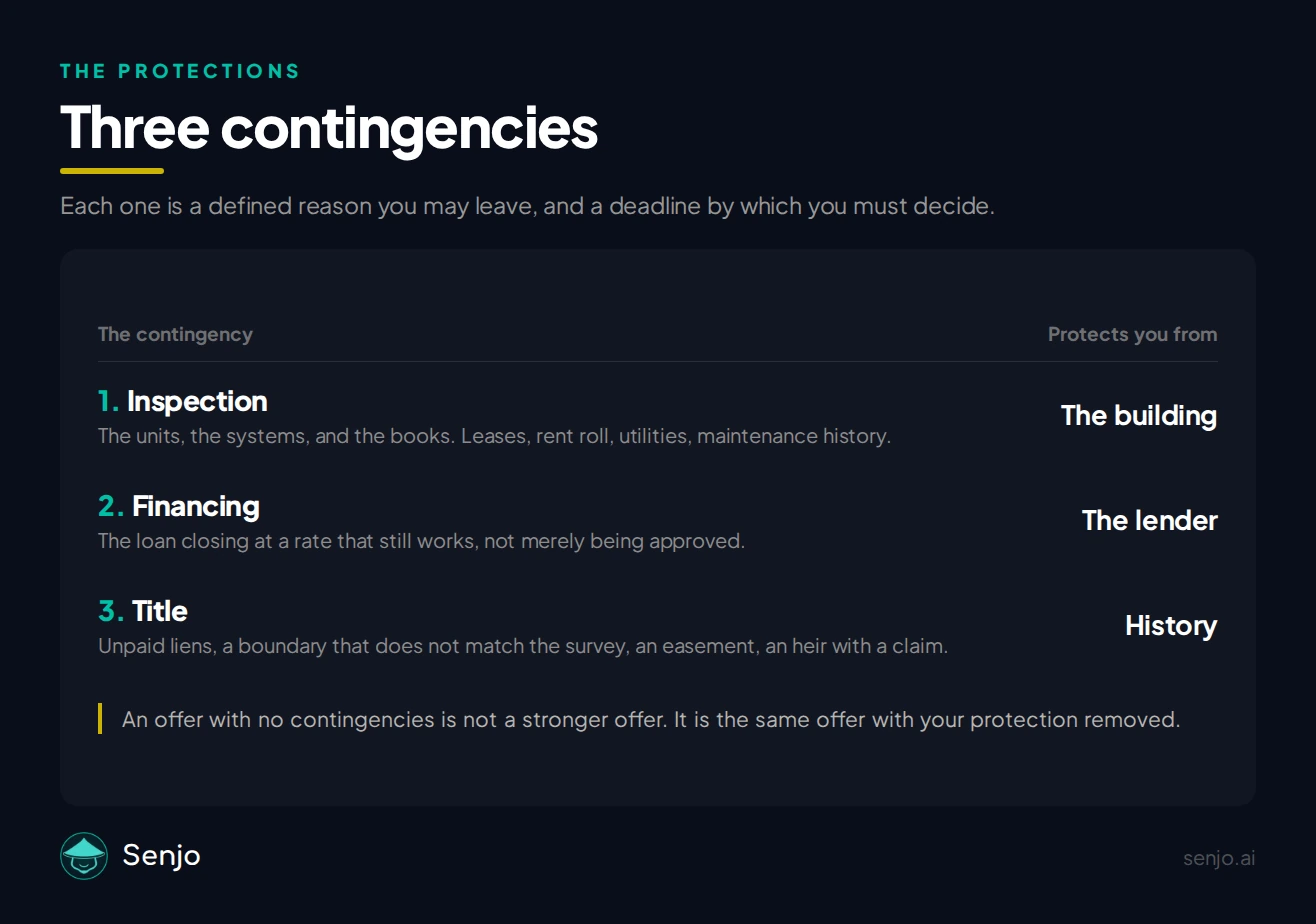
The inspection contingency protects you from the building. It gives you a defined window to examine the property and the records, and to leave if what you find changes the deal. This is not just the physical inspection. It covers the books: the leases, the rent roll, the utility bills, the maintenance history. This window is also when you walk the building, and walking it properly is its own discipline, which is Part 3 of this series.
The financing contingency protects you from the lender. It says the deal only proceeds if you actually get the loan on terms you can live with. Without it, a lender who declines you at the last minute leaves you in breach of contract, deposit and all. Write it to cover terms, not just approval. "I get a loan" and "I get a loan at a rate that still makes this work" are different conditions, and only one of them protects you.
The title contingency protects you from history. It gives you the right to leave if the title search turns up something the seller cannot clear. Unpaid liens, a boundary that does not match the survey, an easement nobody mentioned, an heir with a claim. These are rarer than inspection problems and much harder to fix.
The pattern across all three: each contingency is a defined reason you may leave, and a deadline by which you must decide. Vague contingencies protect nobody, because a condition that cannot be measured cannot be invoked cleanly.
How long should the inspection and financing periods be?
Thirty days each is a common minimum on small multifamily, and shorter windows are usually a mistake on a first deal.
The reason is a difference that surprises almost everyone coming from single family. When you buy a house, most of the work happens before your offer is accepted. You get pre-approved, and the lender does the underwriting up front. That is what "pre" means.
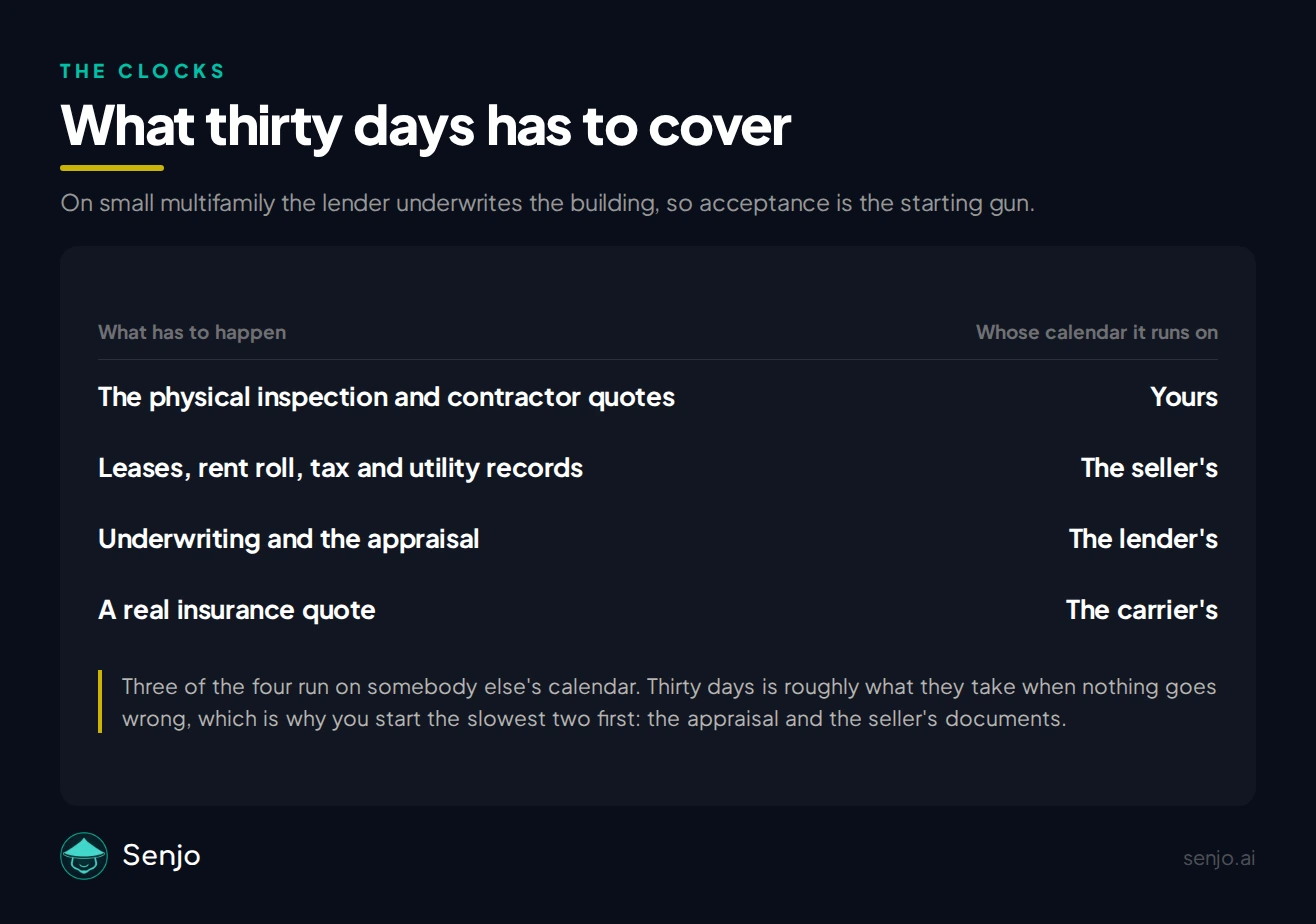
Small multifamily inverts it. The lender is not really underwriting you, they are underwriting the building, and they cannot start until there is a building under contract. So acceptance is not the finish line. It is the starting gun.
Inside those windows you are running several processes at once, and most of them depend on other people. The physical inspection has to be scheduled, every unit you can access walked, and quotes obtained on anything significant. The document review needs leases, rent roll, tax bills, utility history, and service contracts, which the seller has to produce, and on a small mom-and-pop building the records are often disorganised rather than hidden. The lender runs their own underwriting, with an appraisal ordered on their schedule and sometimes an environmental review. And insurance needs a real quote, which on an older building can take longer and come back higher than you assumed.
Thirty days is not generous. It is roughly what those four take when nothing goes wrong.
What is earnest money, and when does it stop being refundable?
It is a deposit that shows the seller you are serious, and it stops being refundable when the contingency that protected it expires.
The phrase you will hear is that the money goes hard. Before that point, walking away for a covered reason gets your deposit back. After it, walking away for the same reason usually does not.
This is why the deadlines above are not administrative. They are the schedule on which your money stops being yours. The sequence people get wrong is simple to describe and expensive to live through: the inspection window closes while you are still waiting on a contractor's quote, and the thing you were waiting to learn is now something you will pay to learn.
Two habits make this manageable. Know the exact date each contingency expires, written somewhere you look at daily, not estimated from memory. And start the slowest items first, which are almost always the lender's appraisal and the seller's document production, because both depend on someone else's calendar.
What happens if you miss a deadline?
At best you ask for an extension and the seller grants it. At worst your protection quietly expires and your deposit is exposed.
Extensions are common and usually granted, especially when the delay is not your fault and you ask early. What sellers respond badly to is being told on the last afternoon. Asking a week out, with a reason, reads as competence. Asking at 4pm on the deadline reads as someone who has lost control of their own transaction.
The deeper point is that momentum is doing real work here. Every day a deal sits, something can go wrong that has nothing to do with you. The seller's circumstances change, a backup buyer gets more aggressive, rates move. Deals rarely die from a single dramatic problem. They die from accumulated delay.
So the working posture through these windows is unglamorous. Answer email the day it arrives. Sign what needs signing. Chase the people who owe you documents. Keep everything for the deal in one place so nothing gets lost in a general inbox.
This is also the stretch where a first-timer feels most overwhelmed, and the feeling is not a signal that something is wrong. It is what a commercial transaction feels like when all the work arrives at once and none of it is familiar yet. The second one is markedly easier, because you know what the sequence is.
When the inspection does change the numbers, and it usually changes them somewhat, the question is not whether the building has problems. It is whether the deal still clears the ceiling you set in Part 1 at the corrected number. That is a calculation, and Senjo will run it against the profile it already holds, your capital position, your cash flow floor, and your credit tier, and tell you the price at which the deal starts working again. Deadlines, paperwork, and contract review stay with you and your attorney.
Frequently asked
What contingencies should be in a small multifamily offer?
Inspection, financing, and title, at a minimum. The inspection contingency covers the building and its records, the financing contingency covers your loan actually closing on workable terms, and the title contingency covers ownership problems the seller cannot clear. Each needs a clear condition and a clear deadline. Your attorney drafts the actual language.
How long should my inspection period be on a small multifamily?
Thirty days is a common minimum and a reasonable target on a first deal. The window has to cover the physical inspection, the seller producing leases and financial records, contractor quotes on anything significant, and an insurance quote. Shorter windows are for buyers who have done this repeatedly and have their team already assembled.
Is earnest money refundable?
While a contingency still protects you and you leave for a reason that contingency covers, generally yes. Once the relevant window closes, the deposit is usually at risk. The exact treatment depends on how the contract is written and on your state, which is why the deadlines matter as much as the amounts.
Why does so much work happen after the offer is accepted?
Because the lender is underwriting the building, not just you, and they cannot start until a specific building is under contract. This is the reverse of a house purchase, where pre-approval front-loads the lender's work. In small multifamily, an accepted offer starts the process rather than finishing it.
Should I waive contingencies to make my offer more competitive?
Not on a first deal. Waiving a contingency does not improve the building or the financing, it only removes your ability to leave when one of them disappoints you. If you need to strengthen an offer, shorter windows, a larger deposit, or a faster close are levers that cost you less than giving up your exit.
What if the seller will not produce the documents I asked for?
Ask through the broker, in writing, and note the date. Disorganised records on a long-held family building are common and are usually not concealment. What matters is whether you can get enough to underwrite confidently before your window closes. If you cannot, that is a reason to ask for an extension, and if the extension is refused, a reason to consider leaving while your deposit is still protected.
Senjo is an AI sensei for solo multifamily investors. Fernando, its founder, owns two single family rentals and is working toward his first small multifamily deal, building the tool he needed when he got stuck between the two.